Background photo credit: Peter Ferguson https://catalog.ontarionature.org/ontario-reptile-and-amphibian-atlas/page/82-83
Hidden In Plain Sight: Muskoka’s Frogs And Toads
VOICES OF SPRING AND INDICATORS OF A HEALTHY LAKE
Muskoka is home to a rich and diverse community of frogs and toads. From the long trill of the American Toad to the joyful sound of Spring Peepers, these amphibians are among the first and most recognizable signs of seasonal change.
Herps of Ontario For all types of reptile and amphibian sightings (it also serves as the main database for Ontario Nature)
Frogs and toads are amphibians, meaning they live part of their lives in water and part on land. They belong to the order Anura, a group of tailless, cold-blooded vertebrates that typically begin life as aquatic tadpoles before transforming into air-breathing adults. Although often treated as separate animals, toads are actually a type of frog - generally those adapted to drier environments with rougher skin.
Beyond their sounds, frogs and toads play a critical ecological role. They help control insect populations - consuming mosquitoes, flies and other pests - and serve as important indicators of environmental health. Because their skin is highly permeable, they are especially sensitive to pollution and habitat changes.
Did you know toads absorb water through their skin? Well, they’ll absorb pesticides the same way. These chemicals don’t just harm toads directly – they also eliminate the insects that toads depend on for survival. If you really want to help toads in your area, your backyard needs to be a pesticide-free sanctuary. You won’t miss those chemicals anyway – the toads will handle pest control naturally!
The importance of monitoring amphibians to better understand environmental changes cannot be understated. iNaturalist has two projects, both are supported by the Adopt-A-Pond program at the Toronto Zoo, so data from either helps inform provincial conservation initiatives. Observations can be submitted online or via app (both iOS and Android).
Herps of Ontario For all types of reptile and amphibian sightings (it also serves as the main database for Ontario Nature)
Commonly Found Frog and Toad Species in Muskoka
Based on observations from the iNaturalist Herps of Ontario project, at least 10 frog and toad species have been observed in Muskoka (here they are organized by # of sightings, highest to lowest):
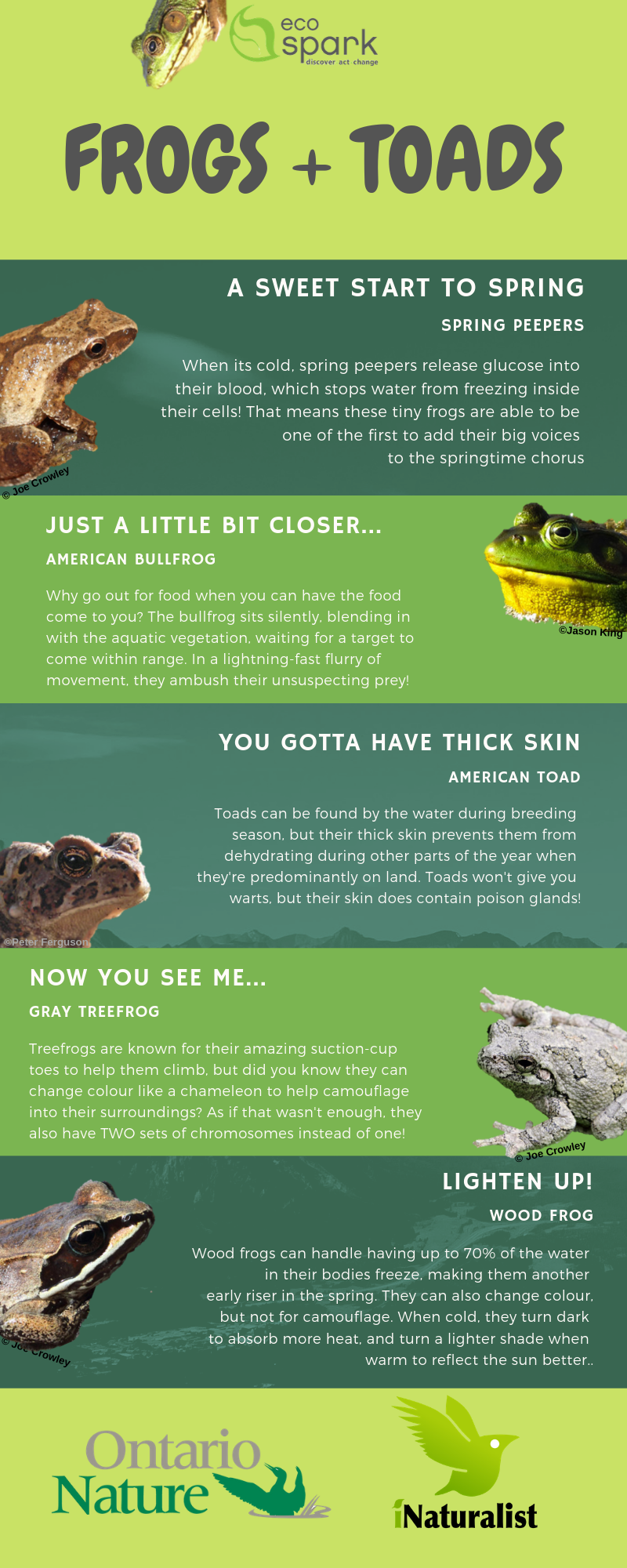
American Toad
American Toad
- Dry, bumpy skin; pale stripe down the back
- Long, musical trill heard in late spring
- Found in forests, gardens, and fields
- Green to brown; ridge runs partway down the back
- Call sounds like a loose banjo string
- Common along shorelines of lakes and ponds
- Distinct round "leopard" spots
- Prefers wet meadows and grassy wetlands
- Populations have declined in some areas, making sightings important
- Largest frog in Ontario
- Deep "jug-o-rum" call
- Found in large, permanent water bodies
- Tiny frog with an "X" marking on its back
- Loud, high-pitched "peep!" chorus in early spring
- Can change colour from gray to green
- Sticky toe pads for climbing
- Short, buzzy trill; can survive partial freezing
- Brown with a dark "mask" across the eyes
- Duck-like quacking call
- Famous for its ability to freeze solid in winter and thaw in spring
- Associated with cool northern lakes
- Call sounds like tapping or knocking
- Emits a musky odour when handled
- Square spots in neat rows
- Prefers cool, clear water
- Produces mild skin toxins (unique among Ontario frogs)
- Small, striped frog
- Rapid, raspy trill in very early spring
- Often breeds in shallow, temporary wetlands
Frog vs. Toad: What’s the Difference?
While all toads are technically frogs, there are some helpful general differences:
Habitat and Seasonal Behaviour
Frogs and toads depend on a mix of wetlands, forests, and shoreline habitats throughout their life cycle.
While all toads are technically frogs, there are some helpful general differences:
- Frogs: Smooth, moist skin; long legs; strong jumpers; closely tied to water
- Toads: Dry, warty skin; shorter legs; tend to walk or hop; more adapted to land
Habitat and Seasonal Behaviour
Frogs and toads depend on a mix of wetlands, forests, and shoreline habitats throughout their life cycle.
Breeding
One of the easiest ways to identify frogs is by their calls:
- Most species lay eggs in shallow water such as ponds, marshes, or temporary pools
- Eggs hatch into tadpoles, which later transform into adults
- Frogs typically lay eggs in clusters, while toads lay them in long strings
- Found in moist forests, under logs, in leaf litter, or even backyard gardens
- Toads are especially adaptable and often live away from water except during breeding
- Some species, like Wood Frogs and Gray Treefrogs, produce natural "antifreeze" compounds that allow them to survive freezing temperatures
- Others overwinter underwater or buried in soil
One of the easiest ways to identify frogs is by their calls:
- Early Spring: Chorus Frogs, Wood Frogs, Spring Peepers
- Late Spring: American Toads
- Summer: Green Frogs and Bullfrogs
- Create a naturalized yard with native plants and shelter
- Avoid pesticides and chemical fertilizers
- Maintain or protect small wetlands or ponds
- Leave leaf litter and logs for shelter
- Participate in citizen science programs like FrogWatch and Herps of Ontario
Know Before You Mow
HERE ARE THE BEST WAYS TO AVOID MOWING TOADS IN THE LAWN
Mowing Techniques and Strategies
- Mow from Inside Out: Instead of mowing in circles from the outside in (which traps small animals in the center), start in the middle and work outward. This allows toads to escape to the safety of the surrounding, uncut grass.
- Raise the Blade: Set your mower to its highest setting. This leaves the grass longer, providing shade for toads and allowing the mower deck to pass over them without contact.
- "Toad Patrol" (Pre-Mow Inspection): Walk your lawn before mowing to scare toads away. Walking through the grass, shuffling your feet, or using a weed whacker first can cause them to hop away.
- Mow in Sections: Instead of doing the whole lawn, mow in sections on different days. This gives toads a safe, uncut refuge area.
- Use a Scythe or String Trimmer: For areas with high toad populations, an old-fashioned scythe or a weed whacker allows for more control and makes noise that encourages them to move.
- Mow When It's Hot and Dry: Toads are less active during the hottest part of the day, as they prefer to stay in moist, shaded areas. Mowing at this time reduces the chance of them being out in the open.
- Avoid Mowing After Rain: Toads and frogs are most active and likely to be out in the open after rain. Waiting for the lawn to dry ensures they have likely returned to cooler, hidden spots.
- Time It for Evening/Morning: If not mowing in the heat, do it during times when you can see them clearly to avoid them.
- Reduce Shelters in High-Traffic Areas: Keep the lawnmower-friendly areas clear of debris, such as leaf piles or wood, to make them less attractive for toads to hide during the day.
- Create Designated Safe Zones: Make a "toad abode" by placing a broken clay pot or creating a brush pile in a shady, unmowed corner of your garden. Toads will often move to these areas, away from the mower.
- Create "No-Mow" Zones: Leave a strip of longer grass along fence lines or property edges to serve as a natural, safe habitat.