BENTHIC MACROINVERTEBRATE IDENTIFICATION AND MONITORING
Some people do not like the squishy feel of a lake bottom. But that squishiness is just muck primarily composed of decaying organic matter like plants and leaves. It plays a critical role in the aquatic ecosystem, feeding and supporting many beneficial insects in their first stage of life as nymphs. Think of that soft bottom as the forest floor of the lake. Just like leaves break down in the woods, plants and natural materials break down in the water. It might feel strange, but it’s part of what keeps Echo Lake healthy.
By the way, when dragonflies come out of their larval stage in the water, you’ll see some of their carcasses clinging to different things around your house and property. They look like something out of a horror movie! It's hard to believe that a beautiful dragonfly came out of it!
If someone just can’t get past the squishy feeling, even knowing it’s actually a sign of a living, healthy lake, here are a few simple options:
By the way, when dragonflies come out of their larval stage in the water, you’ll see some of their carcasses clinging to different things around your house and property. They look like something out of a horror movie! It's hard to believe that a beautiful dragonfly came out of it!
If someone just can’t get past the squishy feeling, even knowing it’s actually a sign of a living, healthy lake, here are a few simple options:
- Wear water shoes or sandals. A thin sole removes the squishy sensation almost entirely.
- Swim from a dock. Jumping or climbing in from deeper water avoids walking on the bottom.
- Look for a sandy entry point. If you don’t have one, the public access area at the intersection of Hammond Road and Echo Lake Road is a nice spot and it’s not squishy.
- Use a floating mat or kayak. Entering the water from floating equipment bypasses the shoreline altogether.
Monitoring Results for Echo Lake
The District Municipality of Muskoka has been monitoring bottom-dwelling aquatic invertebrate communities since 2003: Recreational Water Quality Monitoring Program.
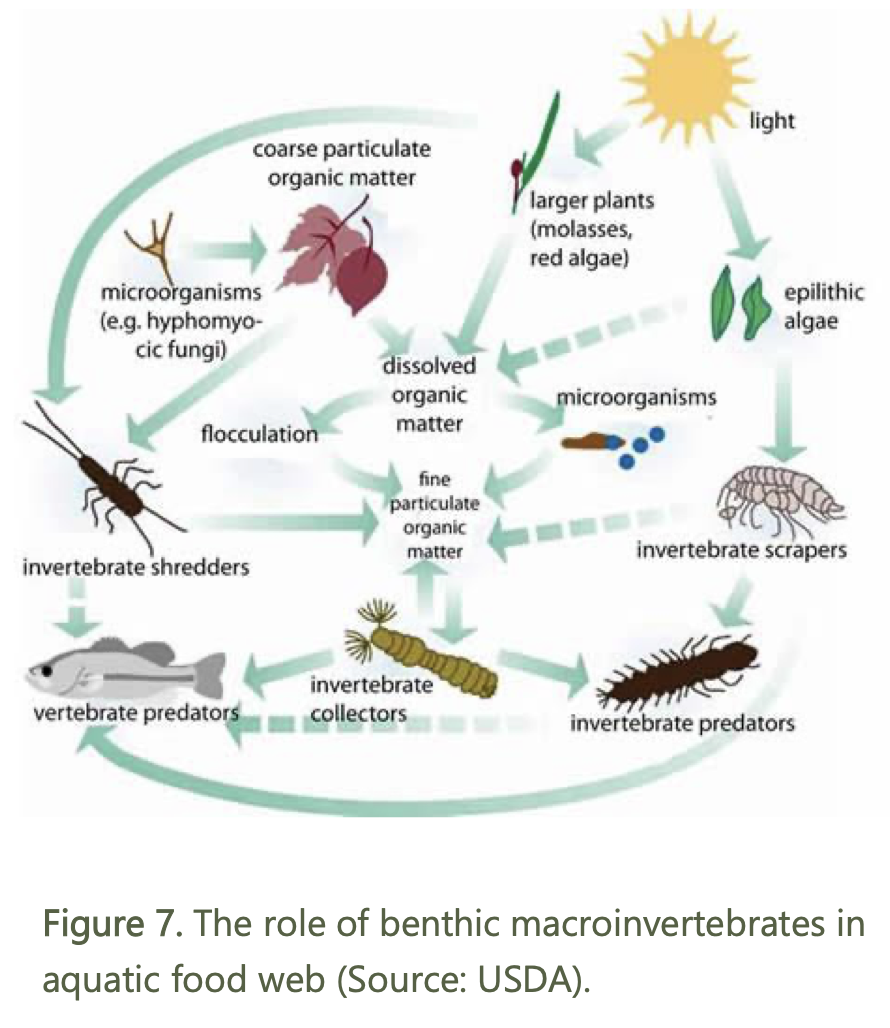
The program uses aquatic insects and other small organisms that live in the bottom sediments of lakes, called benthos, to assess long-term water quality and ecosystem health. These invertebrates, such as worms, mollusks, insects, crustaceans and mites, are sensitive to environmental changes like pollution or habitat alteration, and indicate the health of lakes and streams. Like many species, insects are declining due to loss of habitat, indiscriminate and widespread insecticide and pesticide applications, and climate change.
Echo Lake
Results for Echo Lake are included in the District of Muskoka's Lake System Health Water Quality Monitoring Program 2025 Annual Report - Click Here
In 2026, Echo Lake volunteers assisted the District of Muskoka's Biological Monitoring Technician with counting.
And the results are in:
1. Richness should be high (close to the average for Muskoka or above).
2. % EOT will decrease and % Chironomids will increase over time with water quality impairment.
3. % Predators should be less than the other types of benthos (shredders, collector/gatherers) and these percentages should remain relatively constant over time.
4. The Hilsenhoff Index value should be close to the average for Muskoka or less, as a lower value indicates healthier water.
Site 1 (Reference Site)
Richness is slightly above the Muskoka average, suggesting good biodiversity at this site. %EOT is well above the Muskoka average and %Chironomids are low, indicating a strong presence of pollution-sensitive species and little evidence of water quality impairment. %Predators are considerably higher than the Muskoka average, while collector/gatherers are lower, suggesting a shift in community structure. The Hilsenhoff Index is below the Muskoka average, indicating good water quality with little evidence of environmental stress.
Site 2
Richness is below the Muskoka average, suggesting somewhat reduced biodiversity at this site. However, %EOT is well above the Muskoka average and %Chironomids remain low, indicating a strong presence of pollution-sensitive species and little evidence of water quality impairment. %Predators are considerably higher than the Muskoka average, while collector/gatherers are much lower, indicating a notable shift in community structure. The Hilsenhoff Index is below the Muskoka average, suggesting good water quality with little evidence of environmental stress.
These data sheets are also available through The Muskoka Water Web (go to Muskoka Resources >> Lake System Health Data >> Biological Monitoring Data)
Question from Cheryl: Predators being higher than the Muskoka average + collector/gatherers being lower: This "shift in community structure” is not good, right? Is there anything we can do to resolve that?
Answer: For the higher percentage of predators and lower percentage of collector/gatherers, I wouldn’t necessarily consider this a negative result on its own. It indicates that the community composition at the site differs somewhat from the Muskoka average, but these percentages can naturally vary depending on habitat, available food sources, and other environmental conditions. There also isn’t really a specific action needed to “correct” this balance. Looking at the results as a whole, particularly alongside the %EOT, %Chironomids, richness, and Hilsenhoff Index, gives us a much better indication of overall conditions. Monitoring the site over multiple years is also helpful for identifying whether there is a consistent change over time.
Question from Cheryl: I notice Shredders are consistently low - Is there a way we can attract more of them? It sounds like they’re good to have.
Answer: For shredders, they primarily feed on larger pieces of organic material, such as leaves and other plant material entering the water. Their abundance can therefore depend quite a bit on the habitat surrounding the sampling location. Having a low percentage of shredders doesn’t necessarily mean there is a problem or that we need to actively attract more of them. Maintaining natural, vegetated shorelines and allowing natural leaf litter and woody material to provide habitat are some of the best ways to support a diverse benthic community overall. The Muskoka averages are useful reference points, but we don’t necessarily expect every site or lake to match them exactly.
You'll also see Echo Lake data in the Muskoka Watershed Report Card 2023 - Chapter 3: Benthic Macroinvertebrates In Muskoka - Click Here
How the Program Works
1. Site Selection
Monitoring sites are chosen around lakes throughout Muskoka. Sites are often sampled annually or on a rotating schedule to track changes over time.
2. Field Sampling
Technicians collect samples using the Ontario Benthos Biomonitoring Network (OBBN) protocol. At each site:
1. Site Selection
Monitoring sites are chosen around lakes throughout Muskoka. Sites are often sampled annually or on a rotating schedule to track changes over time.
2. Field Sampling
Technicians collect samples using the Ontario Benthos Biomonitoring Network (OBBN) protocol. At each site:
- A kick-and-sweep net is used in shallow water.
- The substrate is disturbed by kicking the bottom and agitating vegetation, rocks, and woody debris.
- Organisms dislodged from the habitat are captured in the net.
- Multiple sweeps are combined into a single representative sample for the site.
3. Sample Processing
Samples are the taken to a counting area where more volunteers are encouraged to join in the catch and count! At the count:
- Organisms are sorted from sediment and debris.
- Typically, 100 organisms are identified from each sample.
- Organisms are identified to family level according to OBBN standards.
Several biological indicators are calculated:
Richness
The number of different benthic families found.
- Higher richness generally indicates better biodiversity and ecosystem health.
- Muskoka average is approximately 13 families.
The percentage of:
- Ephemeroptera (Mayflies)
- Odonata (Dragonflies and Damselflies)
- Trichoptera (Caddisflies)
- Higher % EOT suggests healthier water conditions.
The percentage of non-biting midges.
- Chironomids are more tolerant of environmental stress.
- Higher percentages can indicate poorer water quality.
Organisms are grouped based on how they obtain food:
- Collector/Gatherers
- Shredders
- Predators
- Scrapers
- Filter Feeders
Hilsenhoff Biotic Index (HBI)
Each benthic family has a pollution tolerance value.
The HBI combines these values into a single score:
- Lower scores indicate better water quality.
- Higher scores indicate greater organic pollution or environmental stress.
A healthy Muskoka benthic community typically shows:
- High richness
- Elevated % EOT
- Low % Chironomids
- Predators making up a smaller portion of the community than collector/gatherers
- A Hilsenhoff Index near or below the Muskoka average (about 6.27)
The District's detailed protocol for the testing is here: http://www.smlca.ca/uploads/2/3/8/2/23822260/benthicmonitoringinfo.pdf
Can you help Echo Lake? We're Looking for Monitoring Volunteers
Currently, the District's technician samples two sites, both at Cairn Camp. The Echo Lake Association has arranged for additional sampling sites (TBD) to be monitored starting in 2027. This will be an annual test as part of the Environmental Officer role, but volunteers are appreciated to speed up the counting process.
There are three categories: Potential Concern (PC), Typical (T), and Insufficient Data (ID). Echo Lake's status is currently classified as TYPICAL.
But, since 2021, our lake is being tested only once a year, so we don't know if that's actually true. More data is always needed, especially in quaternary watersheds.
The Echo Lake Association has reached out to the District Of Muskoka’s Biological Monitoring Program and we are now a PROGRAM PARTNER 🙌. Now we can collect more benthic data for our lake. The District provides the expertise, training and equipment, we would provide the volunteers.
But we will need your help! Please email us at elamuskoka@gmail.com if you would like to participate 🙏
There are three categories: Potential Concern (PC), Typical (T), and Insufficient Data (ID). Echo Lake's status is currently classified as TYPICAL.
But, since 2021, our lake is being tested only once a year, so we don't know if that's actually true. More data is always needed, especially in quaternary watersheds.
The Echo Lake Association has reached out to the District Of Muskoka’s Biological Monitoring Program and we are now a PROGRAM PARTNER 🙌. Now we can collect more benthic data for our lake. The District provides the expertise, training and equipment, we would provide the volunteers.
But we will need your help! Please email us at elamuskoka@gmail.com if you would like to participate 🙏
Have Fun While Getting To Know Your Benthic Community
Learn how Benthic Macroinvertebrates act as vital indicators of water quality and watershed health, based on their tolerance to pollution: Least Tolerant, Moderately Tolerant and Most Tolerant.
A note about crayfish
Echo Lake, as a small, spring-fed lake with rocky shorelines, submerged logs, and shallow, reed-filled bays, makes it highly likely that we have a native crayfish population. Additionally, crayfish are a primary food source for smallmouth bass, so their presence is nearly certain.
It is important to note that moving live crayfish between waterbodies is illegal in Ontario.