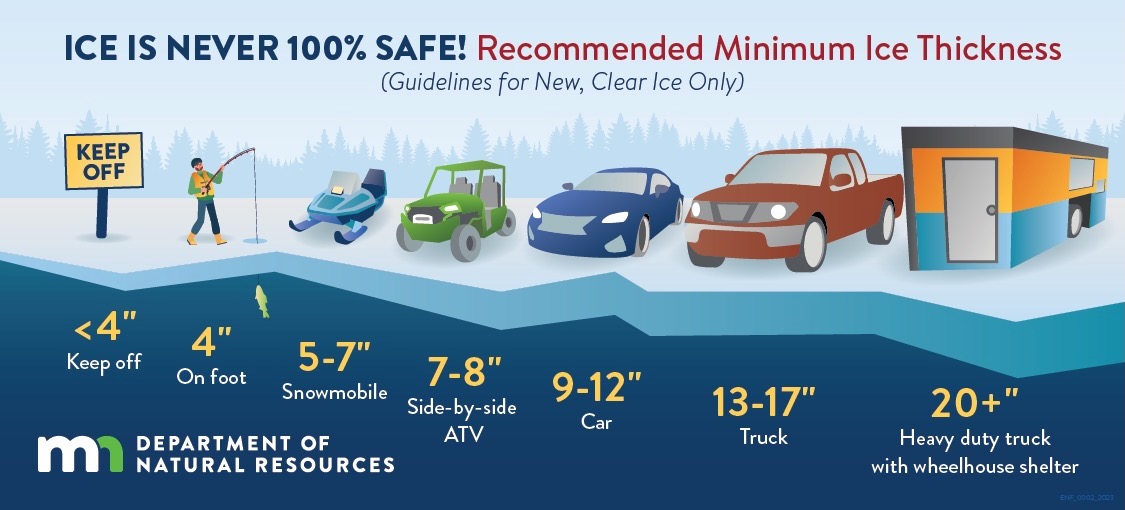
NOTE: DOUBLE THESE THICKNESS GUIDELINES FOR WHITE OR SNOW-COVERED ICE
The only way to be 100 per cent safe around lake ice is to stay off it completely.
❄️ Clear blue ice is strongest
❄️ White opaque or snow ice is half as strong as blue ice – this type of ice forms by wet snow freezing on the ice
❄️ Grey ice is not safe. The ice gets its grey colour from the presence of water.
Ice should be at least:
- 15 cm for walking or skating alone
- 20 cm for group skating or games
- 25 cm for snowmobiles
Ice is seldom the same thickness over a single body of water; it can be two feet thick in one place and one inch thick a few yards away.
Many factors other than thickness affect ice strength, including air temperature, wind, snow, streams, narrow areas or bottlenecks, sun, shade, fish communities, plant decay, and more. When a layer of snow melts and refreezes on top of lake ice, it creates white ice, only about half as strong as new, clear ice.
White ice also forms when rain falls on the snow layer to form slush, which subsequently can freeze and turn into white ice, or when the snow load is sufficient to force lake water to the ice surface through cracks in the ice — conditions that typically occur when air temperatures vary around the freezing point.
If you get into trouble on ice and you're by yourself:
Try to relax and catch your breath. Turn yourself toward shore so you are looking at where you entered onto the ice. The ice is more stable close to shore.
Reach forward onto the broken ice without pushing down. Kick your legs to try to get your body into a horizonal position. Continue kicking your legs, and crawl onto the ice.
When you are back on the ice, crawl on your stomach or roll away from the open area with your arms and legs spread out as far as possible to evenly distribute your body weight. Do not stand up! Look for shore and make sure you are crawling in the right direction.
Rescuing another person can be dangerous. The safest way to rescue is from shore:
Call for help. Consider whether you can quickly get help from trained professionals (police, fire fighters or ambulance) or bystanders.
Check if you can reach the person using a long pole or branch from shore – if so, lie down and extend the pole to the person.
If you go onto ice, wear a PFD and carry a long pole or branch to test the ice in front of you. Bring something to reach or throw to the person (e.g. pole, weighted rope, line or tree branch).
When near the break, lie down to distribute your weight and slowly crawl toward the hole. Remaining low, extend or throw your emergency rescue device (pole, rope, line or branch) to the person.
Have the person kick while you pull them out.