
Chloride in Road Salt + Low Calcium Levels in Muskoka = A Dangerous Liaison
In areas like Muskoka, where calcium levels are naturally low, the additional chloride from road salt can have a compounded effect, making it harder for species to thrive. Calcium is crucial for many aquatic organisms, and when levels are already low, it can weaken their ability to cope with changes in water chemistry, especially those caused by road salt runoff.
Rising salt levels harm aquatic plants and animals, disrupt food webs, contaminate rivers and groundwater, and reduce survival of sensitive species like wood frogs, brook trout, and mussels. Salts also attract land animals to roads, increasing vehicle collisions and threatening wildlife such as moose, elk and deer.
While Echo Lake is not significantly threatened by road salt applications (as indicated below), it is important that we all do our part to protect and safeguard our aquatic ecosystems, forests and wildlife wherever we are.
Chloride (UNALTERED)
- Average 3.4 mg/L (2015-2024)
- Min 2.9 (2015)
- Max 4.1 (2021)
Calcium (NOT STRESSED)
- Average 2.38 mg/L (2010-2024)
- Min 2.18 (2024)
- Max 2.62 (2014)
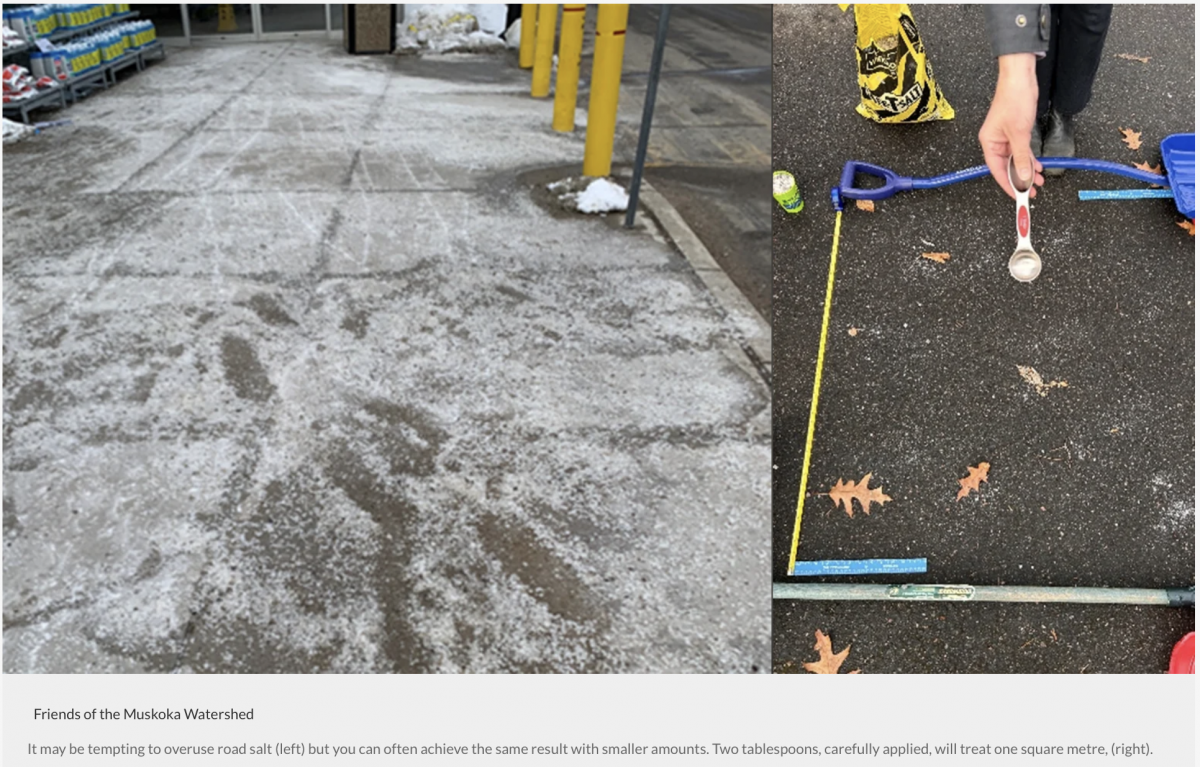
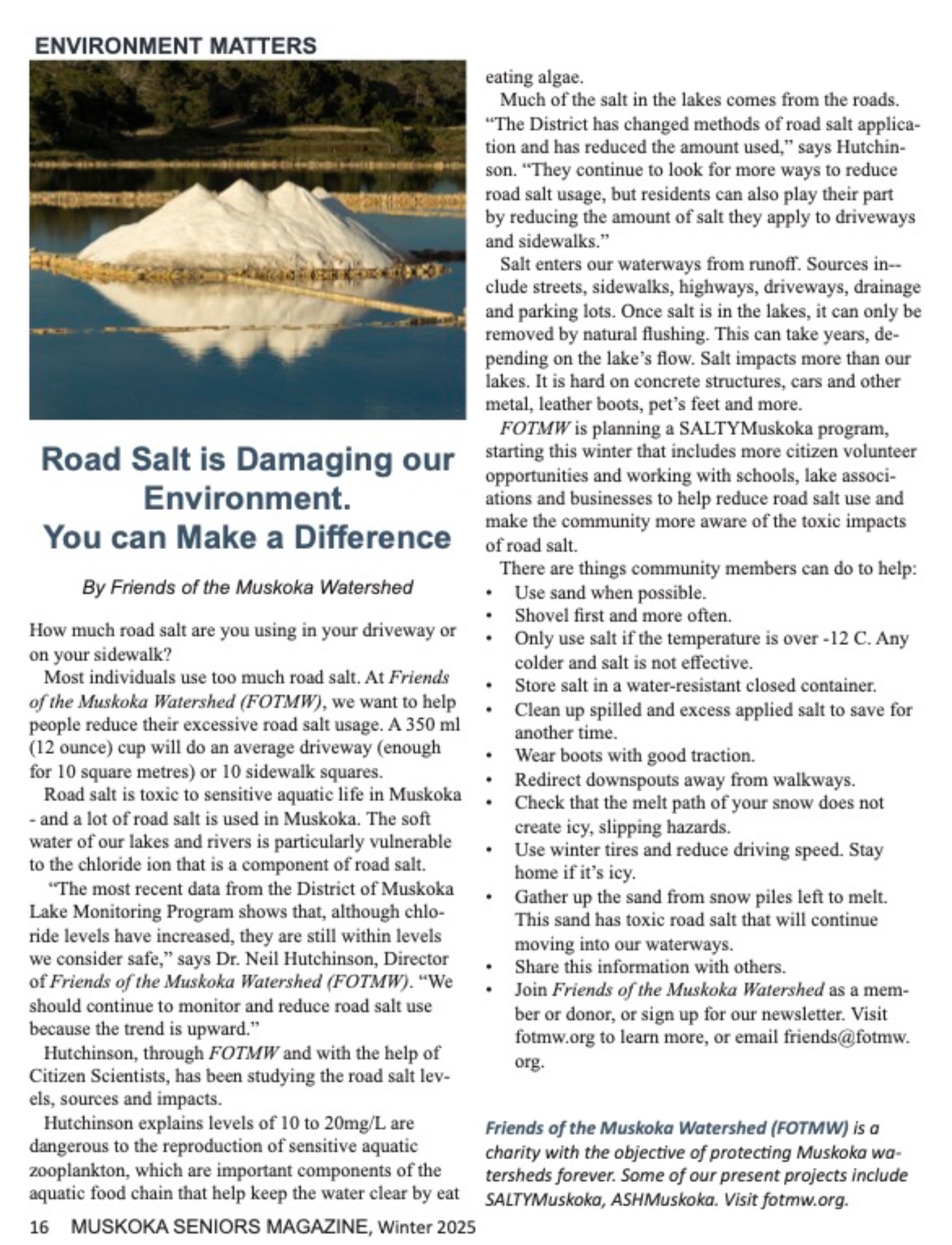
How Much Road Salt Do You Need? — For one square metre, it is just one tablespoon! For an average homeowner's driveway, or 10 sidewalk squares, a cup of road salt should suffice. Also, road salt is ineffective if used in temperatures below 10 degrees celsius.
Additional resources:
Muskoka Watershed Report Card - Chapter 4: CHLORIDETake ActionOntario Road Salt Alternatives: From Beet To Pickle Juice
DIVE DEEPER
BELOW, YOU'LL FIND AN ARTICLE PUT TOGETHER FROM TWO WEBINARS.
MANY OF US HAVE OTHER PROPERTIES WHERE ROAD SALT IS MORE PREVALENT, AS SUCH, YOU MAY BENEFIT FROM THIS ADDITIONAL INFORMATION:
MANY OF US HAVE OTHER PROPERTIES WHERE ROAD SALT IS MORE PREVALENT, AS SUCH, YOU MAY BENEFIT FROM THIS ADDITIONAL INFORMATION:
Road Salt and Freshwater: Understanding the Problem and Finding Solutions
Each winter, millions of tonnes of road salt are spread across roads, sidewalks, parking lots and driveways to keep people safe. While salt is effective at melting ice, scientists are increasingly concerned about its long-term impact on freshwater ecosystems.
Why Road Salt Is Used
Using salt on roads is not a new practice. In Canada, road salt began to be used experimentally in the 1940s. It quickly proved to be an effective way to melt ice and improve winter driving conditions. Salt works by lowering the freezing point of water, which melts existing ice and helps prevent new ice from forming. By the 1970s, it had become the most common method for winter de-icing. Most road salt is sodium chloride, although other compounds such as magnesium chloride and calcium chloride are also used. Salt may be applied as rock salt or as a liquid brine solution. Because it is inexpensive, abundant, and effective, road salt has become a central tool for winter maintenance across North America.
Where the Salt Goes
Once applied, salt does not disappear. It dissolves into sodium and chloride ions which are carried by melting snow and rain into soil, streams, wetlands, lakes, and groundwater. Ontario uses more road salt than any other Canadian province. Millions of tonnes are applied each winter. Even these estimates may be low, because reporting to Environment and Climate Change Canada is voluntary and does not include salt used by private businesses or homeowners. Freshwater lakes and rivers normally contain 1 to 100 milligrams of chloride per litre. When concentrations rise beyond natural levels, chloride becomes toxic to freshwater ecosystems.
Rising Chloride Levels
Monitoring across Ontario shows that chloride levels have been rising for decades. A report from Ontario’s Auditor General found that chloride concentrations in streams have been increasing for more than 50 years, largely due to road salt use. In 2001, Environment Canada concluded that road salts containing chloride have harmful environmental effects and listed them as toxic under the Canadian Environmental Protection Act. In response, the federal government introduced the Code of Practice for the Environmental Management of Road Salts, encouraging better storage, handling and application practices. Despite these measures, many lakes and rivers are becoming progressively saltier.
Environmental Impacts of Road Salt
Salt pollution affects ecosystems, infrastructure, and drinking water in several ways:
Harm to Aquatic Life
At moderate to high concentrations, chloride is toxic to many freshwater organisms, including:
Urban Streams Are Especially Affected
The impacts of road salt are particularly visible in urban watersheds. Monitoring by the Toronto and Region Conservation Authority found that in 2023:
Changes to Lake Ecosystems
Salt can also alter the physical structure of lakes. Normally, lakes mix in spring and fall, distributing oxygen and nutrients between surface and deep water. Increasing salinity changes water density, which can interfere with this mixing process. When mixing is reduced:
Damage to Infrastructure
Salt is also highly corrosive. It damages:
Risks to Drinking Water
Salt can also affect drinking water supplies. Chloride easily infiltrates groundwater and wells, where it can accumulate over time because it does not break down naturally. Ontario’s drinking water objective for chloride is 250 mg/L, primarily to prevent unpleasant taste and corrosion. Between 2002 and 2019, about 11% of groundwater monitoring wells in Ontario exceeded this level. Corrosion caused by salt can also increase the risk that metals such as lead or copper will leach from older plumbing systems.
A Growing Issue for the Great Lakes
Salt pollution is also becoming a concern for the Great Lakes. Research shows that chloride concentrations have been increasing for more than a century. Yet within the Great Lakes Water Quality Agreement, there are currently no enforceable limits for salt, only guidelines. Scientists warn that rising salinity could have several effects:
Why Public Awareness Is Still Low
Despite decades of research, many people are unaware that road salt can be a pollutant. A survey conducted by Watersheds Canada found that nearly 30% of respondents did not know that road salt harms freshwater ecosystems. One reason is that salt feels familiar and harmless. It is used in cooking and food preservation, so it is rarely thought of as an environmental contaminant. Another factor is public expectation. Many people expect roads, sidewalks and parking lots to remain completely clear of snow and ice throughout winter. This expectation often leads to excessive salt use. In reality, applying more salt does not necessarily improve safety. In some cases, excess salt crystals can even create slippery conditions.
The Challenge of Reversing Salt Pollution
Once salt enters waterways, it is extremely difficult to remove. Unlike many pollutants, chloride does not evaporate, degrade or break down. It simply accumulates over time. Because removal is impractical at large scales, the most effective solution is to reduce the amount of salt applied in the first place.
Community Solutions: The Muskoka Example
One community initiative tackling the problem is the Salty Muskoka Community Action Project, led by the Friends of the Muskoka Watershed. The project focuses on reducing salt use from private and commercial properties, which may account for roughly 20% of road salt pollution. Key initiatives include:
One simple tool promoted by the project is the Green Cup, which helps people measure how much salt they apply. A single green cup, about 350 ml, is the recommended amount of salt for an average driveway. In theory, a 10-kilogram bag of road salt should last about 29 driveway treatments, far longer than what many people currently use. The message is simple: Use tools first, salt last.
Practical Ways to Reduce Salt Use
Small changes can significantly reduce salt pollution:
Rethinking Winter Maintenance
There is no single replacement for road salt. Alternatives such as brine solutions, sand and other materials can reduce salt use, but each comes with trade-offs. Some solutions require specialized equipment or training. Research shows that switching from dry salt to brine can reduce salt use by up to 50%, but broader changes are still needed. Experts emphasize that winter safety cannot rely on chemicals alone. Solutions must include:
Many experts believe the most promising path forward is improved regulation and training. Currently, winter maintenance contractors face liability risks but lack consistent provincial standards. Mandatory certification and clearer guidelines could help ensure safer and more responsible salt use. There is growing support for these measures from municipalities, conservation authorities, environmental organizations and industry groups. More than two dozen local governments in Ontario, including the Township Of Lake Of Bays, have already passed resolutions urging the province to strengthen road salt management.
A Watershed Approach
Many scientists advocate for a watershed-based approach to salt management. Every watershed is different. Some may be most affected by municipal roads, while others may be dominated by residential driveways or commercial parking lots. Understanding where salt enters each watershed allows communities to target solutions more effectively.
Everyone Has a Role to Play
Ontario contains more than 200,000 lakes and 500,000 kilometres of rivers and streams - some of the world’s most valuable freshwater resources. Protecting them will require action from:
Why Road Salt Is Used
Using salt on roads is not a new practice. In Canada, road salt began to be used experimentally in the 1940s. It quickly proved to be an effective way to melt ice and improve winter driving conditions. Salt works by lowering the freezing point of water, which melts existing ice and helps prevent new ice from forming. By the 1970s, it had become the most common method for winter de-icing. Most road salt is sodium chloride, although other compounds such as magnesium chloride and calcium chloride are also used. Salt may be applied as rock salt or as a liquid brine solution. Because it is inexpensive, abundant, and effective, road salt has become a central tool for winter maintenance across North America.
Where the Salt Goes
Once applied, salt does not disappear. It dissolves into sodium and chloride ions which are carried by melting snow and rain into soil, streams, wetlands, lakes, and groundwater. Ontario uses more road salt than any other Canadian province. Millions of tonnes are applied each winter. Even these estimates may be low, because reporting to Environment and Climate Change Canada is voluntary and does not include salt used by private businesses or homeowners. Freshwater lakes and rivers normally contain 1 to 100 milligrams of chloride per litre. When concentrations rise beyond natural levels, chloride becomes toxic to freshwater ecosystems.
Rising Chloride Levels
Monitoring across Ontario shows that chloride levels have been rising for decades. A report from Ontario’s Auditor General found that chloride concentrations in streams have been increasing for more than 50 years, largely due to road salt use. In 2001, Environment Canada concluded that road salts containing chloride have harmful environmental effects and listed them as toxic under the Canadian Environmental Protection Act. In response, the federal government introduced the Code of Practice for the Environmental Management of Road Salts, encouraging better storage, handling and application practices. Despite these measures, many lakes and rivers are becoming progressively saltier.
Environmental Impacts of Road Salt
Salt pollution affects ecosystems, infrastructure, and drinking water in several ways:
Harm to Aquatic Life
At moderate to high concentrations, chloride is toxic to many freshwater organisms, including:
- Fish
- Amphibians
- Aquatic plants
- Insects and crustaceans
- 120 mg/L chloride for long-term exposure
- 640 mg/L chloride for short-term exposure
Urban Streams Are Especially Affected
The impacts of road salt are particularly visible in urban watersheds. Monitoring by the Toronto and Region Conservation Authority found that in 2023:
- 72% of monitoring stations had chloride levels above the long-term guideline
- 81% showed increasing trends
Changes to Lake Ecosystems
Salt can also alter the physical structure of lakes. Normally, lakes mix in spring and fall, distributing oxygen and nutrients between surface and deep water. Increasing salinity changes water density, which can interfere with this mixing process. When mixing is reduced:
- Deep waters may lose oxygen
- Fish habitat becomes limited
- Nutrient cycles can change
Damage to Infrastructure
Salt is also highly corrosive. It damages:
- Bridges and roads
- Vehicles
- Stormwater systems
- Water pipes
Risks to Drinking Water
Salt can also affect drinking water supplies. Chloride easily infiltrates groundwater and wells, where it can accumulate over time because it does not break down naturally. Ontario’s drinking water objective for chloride is 250 mg/L, primarily to prevent unpleasant taste and corrosion. Between 2002 and 2019, about 11% of groundwater monitoring wells in Ontario exceeded this level. Corrosion caused by salt can also increase the risk that metals such as lead or copper will leach from older plumbing systems.
A Growing Issue for the Great Lakes
Salt pollution is also becoming a concern for the Great Lakes. Research shows that chloride concentrations have been increasing for more than a century. Yet within the Great Lakes Water Quality Agreement, there are currently no enforceable limits for salt, only guidelines. Scientists warn that rising salinity could have several effects:
- Favouring invasive species that tolerate higher salt levels
- Reducing ice formation in winter
- Altering lake stratification and oxygen levels
Why Public Awareness Is Still Low
Despite decades of research, many people are unaware that road salt can be a pollutant. A survey conducted by Watersheds Canada found that nearly 30% of respondents did not know that road salt harms freshwater ecosystems. One reason is that salt feels familiar and harmless. It is used in cooking and food preservation, so it is rarely thought of as an environmental contaminant. Another factor is public expectation. Many people expect roads, sidewalks and parking lots to remain completely clear of snow and ice throughout winter. This expectation often leads to excessive salt use. In reality, applying more salt does not necessarily improve safety. In some cases, excess salt crystals can even create slippery conditions.
The Challenge of Reversing Salt Pollution
Once salt enters waterways, it is extremely difficult to remove. Unlike many pollutants, chloride does not evaporate, degrade or break down. It simply accumulates over time. Because removal is impractical at large scales, the most effective solution is to reduce the amount of salt applied in the first place.
Community Solutions: The Muskoka Example
One community initiative tackling the problem is the Salty Muskoka Community Action Project, led by the Friends of the Muskoka Watershed. The project focuses on reducing salt use from private and commercial properties, which may account for roughly 20% of road salt pollution. Key initiatives include:
- School education programs
- Partnerships with lake associations
- Volunteer monitoring of local waterways
- A community observation network documenting excessive salt use
- Outreach to businesses and property owners
One simple tool promoted by the project is the Green Cup, which helps people measure how much salt they apply. A single green cup, about 350 ml, is the recommended amount of salt for an average driveway. In theory, a 10-kilogram bag of road salt should last about 29 driveway treatments, far longer than what many people currently use. The message is simple: Use tools first, salt last.
Practical Ways to Reduce Salt Use
Small changes can significantly reduce salt pollution:
- Shovel early and often to remove snow before it packs down
- Measure salt carefully rather than spreading it by hand
- Use traction materials like sand when temperatures drop below –10°C
- If using kitty litter, do NOT use the clumping kind - it can be dangerous to birds
- Sweep up excess salt and reuse it
- Store salt in sealed containers to prevent spills
- Direct downspouts away from walkways to reduce refreezing
Rethinking Winter Maintenance
There is no single replacement for road salt. Alternatives such as brine solutions, sand and other materials can reduce salt use, but each comes with trade-offs. Some solutions require specialized equipment or training. Research shows that switching from dry salt to brine can reduce salt use by up to 50%, but broader changes are still needed. Experts emphasize that winter safety cannot rely on chemicals alone. Solutions must include:
- Improved training for winter maintenance professionals
- Better infrastructure design
- Public education
- New technologies
- Policy changes
Many experts believe the most promising path forward is improved regulation and training. Currently, winter maintenance contractors face liability risks but lack consistent provincial standards. Mandatory certification and clearer guidelines could help ensure safer and more responsible salt use. There is growing support for these measures from municipalities, conservation authorities, environmental organizations and industry groups. More than two dozen local governments in Ontario, including the Township Of Lake Of Bays, have already passed resolutions urging the province to strengthen road salt management.
A Watershed Approach
Many scientists advocate for a watershed-based approach to salt management. Every watershed is different. Some may be most affected by municipal roads, while others may be dominated by residential driveways or commercial parking lots. Understanding where salt enters each watershed allows communities to target solutions more effectively.
Everyone Has a Role to Play
Ontario contains more than 200,000 lakes and 500,000 kilometres of rivers and streams - some of the world’s most valuable freshwater resources. Protecting them will require action from:
- Scientists and researchers
- Governments and policymakers
- Municipalities and contractors
- Environmental organizations
- Businesses and property owners
- Everyday residents
Sources:
Salt Pollution in Ontario: Exploring Challenges & Cross-Sector SolutionsAlternatives to Road Salt: Exploring Perspectives & Empowering Action