The Eastern Wolf: The Voice Of The Wild
The haunting howl of a wolf echoing across a lake is one of the most unforgettable sounds of the Canadian wilderness.
What Is an Eastern Wolf?
The Eastern Wolf is a medium-sized member of the canine family. It is typically larger than a coyote but smaller than a grey wolf.
The Eastern Wolf is a medium-sized member of the canine family. It is typically larger than a coyote but smaller than a grey wolf.
Adults generally weigh 20–35 kilograms and have mottled coats ranging from grey-brown to reddish tones. For many years scientists debated whether it was simply a subspecies of the Grey Wolf. Modern genetic research, however, indicates that the Eastern Wolf is a distinct species, more closely related to the endangered Red Wolf of the southeastern United States than to the Grey Wolf. Because of its intermediate size and colouration, it can be extremely difficult to distinguish visually from coyotes and accurate identification often requires genetic testing.
Where Eastern Wolves Live
The Eastern Wolf (or Algonquin Wolf) is found mainly in Algonquin Provincial Park. Outside Algonquin Park, its presence is limited. Smaller populations occur in other protected areas, including:
Where Eastern Wolves Live
The Eastern Wolf (or Algonquin Wolf) is found mainly in Algonquin Provincial Park. Outside Algonquin Park, its presence is limited. Smaller populations occur in other protected areas, including:
- Killarney Provincial Park
- Kawartha Highlands Provincial Park
- Queen Elizabeth II Wildlands Provincial Park
Eastern Wolves prefer mixed and deciduous forest landscapes with abundant prey and relatively low levels of human disturbance. Dens are often located in conifer forests close to water sources, where suitable soil allows them to dig and shelter their pups. Their territories are large, often around 200 square kilometres, and sometimes much larger, reflecting the amount of space required to hunt and raise young.
Pack Life and Hunting
Eastern Wolves live in family-based packs typically made up of a breeding pair and their offspring from the current and previous years. Pups are usually born in late April or early May, with an average litter of about five pups. For the first six to eight weeks they remain at the den while the rest of the pack brings food. Their diet consists mainly of large prey species, including:
Population and Conservation Status
Despite its ecological importance, the Eastern Wolf remains relatively rare. Ontario’s population is estimated at approximately 350 to 1,000 mature individuals. The species faces several ongoing threats, including:
Living Alongside Wolves
Although sightings occasionally occur in rural communities around Muskoka and the Lake of Bays region, Eastern Wolves are naturally shy and avoid people. Conflicts are rare and usually involve unsecured attractants such as garbage or pet food. Wildlife experts recommend a few simple precautions:
The Sound of the Northern Forest
For many visitors to Algonquin and the surrounding highlands, the rising chorus of howls carries across lakes and forests, a reminder that a wild predator still lives in Ontario’s landscapes. Protecting the Eastern Wolf means protecting the forests, wetlands, and wildlife communities that depend on this remarkable species.
Pack Life and Hunting
Eastern Wolves live in family-based packs typically made up of a breeding pair and their offspring from the current and previous years. Pups are usually born in late April or early May, with an average litter of about five pups. For the first six to eight weeks they remain at the den while the rest of the pack brings food. Their diet consists mainly of large prey species, including:
- White-tailed deer
- Moose
- Beaver
Population and Conservation Status
Despite its ecological importance, the Eastern Wolf remains relatively rare. Ontario’s population is estimated at approximately 350 to 1,000 mature individuals. The species faces several ongoing threats, including:
- Habitat loss and fragmentation
- Road mortality
- Hunting and trapping
- Disease such as rabies or mange
Living Alongside Wolves
Although sightings occasionally occur in rural communities around Muskoka and the Lake of Bays region, Eastern Wolves are naturally shy and avoid people. Conflicts are rare and usually involve unsecured attractants such as garbage or pet food. Wildlife experts recommend a few simple precautions:
- Keep pets supervised, especially at night
- Store garbage and food securely
- Do not feed wildlife
- Maintain distance if you encounter a wolf
The Sound of the Northern Forest
For many visitors to Algonquin and the surrounding highlands, the rising chorus of howls carries across lakes and forests, a reminder that a wild predator still lives in Ontario’s landscapes. Protecting the Eastern Wolf means protecting the forests, wetlands, and wildlife communities that depend on this remarkable species.
Coyotes: Ontario’s Adaptable Wild Canine
The coyote is one of the most adaptable and successful wild animals in North America. Once primarily associated with the western plains, coyotes now live across most of Canada, including forests, farmland, and even towns throughout Ontario and Muskoka. Their intelligence and flexibility allow them to thrive in environments where many other large predators struggle.
What Is a Coyote?
Coyotes are medium-sized members of the dog family, smaller than wolves but larger than most foxes. Adults typically weigh between 9 and 23 kilograms and have a lean body, pointed ears, bushy tail and a narrow muzzle. Their fur varies from grey and tan to reddish-brown, often with lighter fur on the throat and belly. In eastern Canada, many coyotes are known as Eastern coyotes because they carry small amounts of wolf ancestry from historical hybridization. This has made them slightly larger than western coyotes and better adapted to hunting deer in forested environments.
Where Coyotes Live
Coyotes are extremely adaptable and can live in a wide range of habitats including:
Diet and Ecological Role
Coyotes are opportunistic omnivores, meaning they eat whatever food is most available. Their diet commonly includes:
Coyotes typically live in small family groups built around a breeding pair. They are generally monogamous and cooperate in raising their young. Key facts about their life cycle include:
How Human Behaviour Shapes Coyote Behaviour
Research increasingly shows that human actions strongly influence coyote behaviour. Feeding wildlife, either intentionally or through unsecured garbage, compost or pet food, can cause coyotes to lose their natural wariness of people. When coyotes become accustomed to human food, they may begin exploring neighbourhoods more frequently. Preventing this 'food conditioning' is one of the most effective ways to reduce conflicts between people and wildlife.
How to Reduce Conflicts with Coyotes
Simple precautions can greatly reduce the chance of wildlife conflicts:
Sharing the Landscape
Coyotes are now a permanent part of Ontario’s wildlife community. Their ability to survive in changing environments, from remote forests to busy towns, demonstrates remarkable resilience. Understanding their behaviour and removing food attractants helps ensure that coyotes remain wary of people while continuing to play their important ecological role in controlling rodents and maintaining balanced ecosystems.
What Is a Coyote?
Coyotes are medium-sized members of the dog family, smaller than wolves but larger than most foxes. Adults typically weigh between 9 and 23 kilograms and have a lean body, pointed ears, bushy tail and a narrow muzzle. Their fur varies from grey and tan to reddish-brown, often with lighter fur on the throat and belly. In eastern Canada, many coyotes are known as Eastern coyotes because they carry small amounts of wolf ancestry from historical hybridization. This has made them slightly larger than western coyotes and better adapted to hunting deer in forested environments.
Where Coyotes Live
Coyotes are extremely adaptable and can live in a wide range of habitats including:
- Forests
- Farmland
- Wetlands
- Suburban neighbourhoods
- Urban parks and ravines
Diet and Ecological Role
Coyotes are opportunistic omnivores, meaning they eat whatever food is most available. Their diet commonly includes:
- Rabbits and rodents
- Deer (especially fawns or weakened animals)
- Birds and insects
- Fruits and berries
- Carrion
Coyotes typically live in small family groups built around a breeding pair. They are generally monogamous and cooperate in raising their young. Key facts about their life cycle include:
- Breeding usually begins in early to mid-February
- Gestation lasts about 60–63 days
- Litters usually contain two to ten pups
How Human Behaviour Shapes Coyote Behaviour
Research increasingly shows that human actions strongly influence coyote behaviour. Feeding wildlife, either intentionally or through unsecured garbage, compost or pet food, can cause coyotes to lose their natural wariness of people. When coyotes become accustomed to human food, they may begin exploring neighbourhoods more frequently. Preventing this 'food conditioning' is one of the most effective ways to reduce conflicts between people and wildlife.
How to Reduce Conflicts with Coyotes
Simple precautions can greatly reduce the chance of wildlife conflicts:
- Keep pets indoors or supervised, especially at night
- Do not leave pet food outdoors
- Secure garbage and compost bins
- Clean up fallen fruit and birdseed
- Keep a safe distance from wildlife
- Never intentionally feed coyotes
Sharing the Landscape
Coyotes are now a permanent part of Ontario’s wildlife community. Their ability to survive in changing environments, from remote forests to busy towns, demonstrates remarkable resilience. Understanding their behaviour and removing food attractants helps ensure that coyotes remain wary of people while continuing to play their important ecological role in controlling rodents and maintaining balanced ecosystems.
Red Fox: The Clever Hunter Of Fields and Forests
With its bright coat, bushy tail, and alert expression, the Red Fox is one of the most recognizable wild mammals in Canada. Found from coast to coast, this adaptable predator thrives in forests, farmland, wetlands and even near towns and cities. Despite its reputation in folklore as sly or mischievous, the red fox is typically a shy and intelligent animal that plays an important role in controlling rodent populations.
Appearance and Colour Variations
The red fox is a small member of the dog family with a slender body, pointed muzzle, upright ears, and a long, bushy tail often tipped in white.
Appearance and Colour Variations
The red fox is a small member of the dog family with a slender body, pointed muzzle, upright ears, and a long, bushy tail often tipped in white.
Adults typically weigh 3.6 to 6.8 kilograms and measure about 90 to 112 centimetres long, with roughly one-third of that length being the tail. Although the name suggests a single colour, red foxes actually come in several colour forms. The most common is the familiar reddish-orange coat with black legs and a white chest. However, other variations include:
Habitat and Range
Red foxes are among the most widely distributed mammals in Canada, occurring in every province and territory. Their success comes from remarkable adaptability. They can live in many types of environments, including:
Skilled Hunters
Red foxes are omnivores, meaning they eat both animals and plants. Their diet changes with the seasons but most often includes:
Family Life
Red foxes are generally solitary animals except during the breeding season. Mating usually occurs in late winter, and the pair will establish a den in an abandoned burrow, hollow log or sheltered area. A typical litter contains four to six kits, which are born in spring. Both parents help raise the young by bringing food back to the den. Sometimes adults even bring live prey for the kits to practice hunting skills. By late summer or autumn, young foxes begin exploring farther from the den and eventually disperse to establish their own territories.
Health Threats: The Impact of Mange
One of the most serious threats to red foxes is mange, a skin disease caused by parasitic mites. Mange leads to hair loss, thickened skin, and intense itching. Severely affected foxes may lose their insulating fur, making it difficult to survive cold winters.The condition is treatable, and wildlife rehabilitators sometimes assist infected foxes by providing medicated bait that helps eliminate the mites.
- Cross fox – a darker coat with black bands across the shoulders forming a cross pattern
- Silver fox – mostly black fur with silvery guard hairs and a white tail tip
Habitat and Range
Red foxes are among the most widely distributed mammals in Canada, occurring in every province and territory. Their success comes from remarkable adaptability. They can live in many types of environments, including:
- Forest edges and woodlots
- Agricultural fields and pastures
- River valleys and marshes
- Suburban neighbourhoods and city parks
Skilled Hunters
Red foxes are omnivores, meaning they eat both animals and plants. Their diet changes with the seasons but most often includes:
- Mice and voles
- Rabbits and hares
- Squirrels
- Birds and eggs
- Insects and earthworms
- Fruits and berries
Family Life
Red foxes are generally solitary animals except during the breeding season. Mating usually occurs in late winter, and the pair will establish a den in an abandoned burrow, hollow log or sheltered area. A typical litter contains four to six kits, which are born in spring. Both parents help raise the young by bringing food back to the den. Sometimes adults even bring live prey for the kits to practice hunting skills. By late summer or autumn, young foxes begin exploring farther from the den and eventually disperse to establish their own territories.
Health Threats: The Impact of Mange
One of the most serious threats to red foxes is mange, a skin disease caused by parasitic mites. Mange leads to hair loss, thickened skin, and intense itching. Severely affected foxes may lose their insulating fur, making it difficult to survive cold winters.The condition is treatable, and wildlife rehabilitators sometimes assist infected foxes by providing medicated bait that helps eliminate the mites.
If you see a fox with mange, here are two wildlife rescue and rehabilitation organizations you should call:
2146 Duck Lake Road, Minden
1116 Crawford Street, Rosseau
How To Tell A Wolf From A Coyote
Because eastern coyotes can be larger than their western relatives, and because wolves sometimes travel outside protected areas, the two animals can look surprisingly similar at first glance.
Why It Can Be Confusing
Eastern coyotes in Ontario contain small amounts of wolf ancestry from historical hybridization. This has made them slightly larger than western coyotes, which is one reason many people mistake them for wolves.
Most sightings near towns or cottages are coyotes. While wolves are present in Lake Of Bays because of our proximity to Algonquin Park, they tend to avoid humans and are seen much less frequently.
Eastern coyotes in Ontario contain small amounts of wolf ancestry from historical hybridization. This has made them slightly larger than western coyotes, which is one reason many people mistake them for wolves.
Most sightings near towns or cottages are coyotes. While wolves are present in Lake Of Bays because of our proximity to Algonquin Park, they tend to avoid humans and are seen much less frequently.
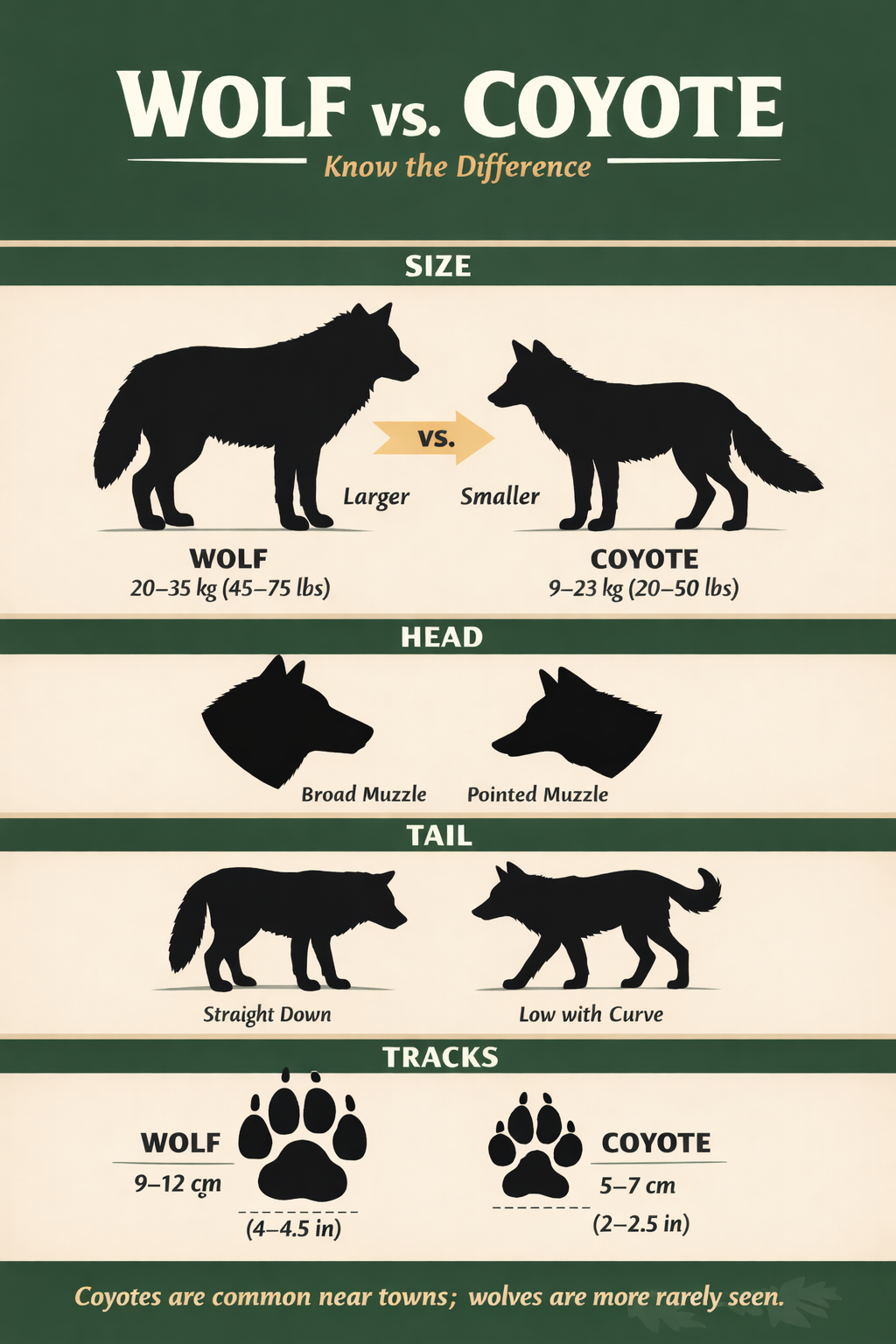
The following quick guide highlights some key differences:
size
Wolf
- Much larger and heavier
- Typically 20–35 kg or more
- Taller, longer legs, broader chest
- Smaller and lighter
- Usually 9–23 kg
- Slimmer body and shorter legs
One of the most reliable differences is the muzzle shape
Wolf
Wolf
- Broad head
- Larger muzzle, with a broad, blocky snout that appears shorter relative to the head, giving the face a powerful, squared-off look.
- Shorter, more rounded ears that appear small compared to the size of their head
- Thicker coats with more uniform colouring, commonly shades of grey or black
- Narrow, elongated muzzle that tapers to a point, often giving the animal a more fox-like appearance.
- Larger, more upright ears that stand out prominently.
- Overall more "fox-like" face
- Tend to have mottled grey, tan, or reddish fur, which can appear patchier
Wolf
- Thicker coats with more uniform colouring, commonly shades of grey or black
- Tend to have mottled grey, tan, or reddish fur, which can appear patchier
Wolf
- Tail hangs straight down and more relaxed when walking
- Moves with a powerful, steady stride
- Tail often held lower with a slight curve
- Lighter, quicker gait
Wolf
- Usually travels in packs
- More secretive and less commonly seen
- Often seen alone or in pairs
- Much more adaptable to human environments
Wolf tracks are large and broad, often compared to the size of a human palm, while coyote tracks are smaller, narrower and more oval-shaped
Wolf
Wolf
- Larger prints (about 9–12 cm long)
- Wide and powerful-looking
- Smaller prints (about 5–7 cm long)
- Narrow and delicate
Coyotes, Wolves, and the "Coywolf" Myth
In eastern North America, people often use the term "coywolf" to describe the larger coyotes seen in forests and suburban areas. The name has become popular in media and conversation, but modern genetic research shows that the reality is more complex. While eastern coyotes do contain some wolf ancestry, scientists emphasize that "coywolf" is not a real species or a scientifically accurate term.
Understanding how these animals evolved helps explain why coyotes in Ontario and the northeastern United States look and behave differently from their western relatives.
The Eastern Coyote: A Hybrid Past
Coyotes originally evolved on the open plains of western North America. Over the last century, however, they expanded eastward across the continent as wolves declined and forests regenerated. During this expansion, some coyotes interbred with wolves and occasionally domestic dogs, creating a genetically mixed population known today as the eastern coyote. Genetic studies show that eastern coyotes are mostly coyote but contain small amounts of wolf and dog DNA. Typical genetic makeup in northeastern populations is approximately:
Why the "Coywolf" Isn’t Real
Although the hybrid ancestry is real, scientists caution that "coywolf" is a misleading label. The word suggests a distinct new animal that is half wolf and half coyote. In reality, eastern coyotes are primarily coyotes with varying amounts of wolf and dog genes, not a separate species or a consistent hybrid type. In fact, genetic tests show there is no single population that is exactly a wolf–coyote cross. Instead, there is a wide range of genetic mixtures across eastern North America. Some coyotes have relatively high wolf ancestry, while others have almost none. Because of this variation, scientists prefer the term "eastern coyote" rather than coywolf.
When Did Hybridization Occur?
Research suggests the hybridization events that produced eastern coyotes occurred roughly 100 years ago, when coyote populations began expanding into the Great Lakes region. At that time, wolf populations were extremely low due to widespread hunting and habitat loss. With few wolves available as mates, some wolves bred with coyotes. Later, as coyotes continued expanding eastward, occasional breeding with domestic dogs also introduced dog genes into the population. Today, however, coyotes almost always breed with other coyotes. Hybridization with wolves or dogs is believed to be rare.
The Eastern Coyote: A Hybrid Past
Coyotes originally evolved on the open plains of western North America. Over the last century, however, they expanded eastward across the continent as wolves declined and forests regenerated. During this expansion, some coyotes interbred with wolves and occasionally domestic dogs, creating a genetically mixed population known today as the eastern coyote. Genetic studies show that eastern coyotes are mostly coyote but contain small amounts of wolf and dog DNA. Typical genetic makeup in northeastern populations is approximately:
- 60–84% coyote
- 8–25% wolf
- 8–11% domestic dog
Why the "Coywolf" Isn’t Real
Although the hybrid ancestry is real, scientists caution that "coywolf" is a misleading label. The word suggests a distinct new animal that is half wolf and half coyote. In reality, eastern coyotes are primarily coyotes with varying amounts of wolf and dog genes, not a separate species or a consistent hybrid type. In fact, genetic tests show there is no single population that is exactly a wolf–coyote cross. Instead, there is a wide range of genetic mixtures across eastern North America. Some coyotes have relatively high wolf ancestry, while others have almost none. Because of this variation, scientists prefer the term "eastern coyote" rather than coywolf.
When Did Hybridization Occur?
Research suggests the hybridization events that produced eastern coyotes occurred roughly 100 years ago, when coyote populations began expanding into the Great Lakes region. At that time, wolf populations were extremely low due to widespread hunting and habitat loss. With few wolves available as mates, some wolves bred with coyotes. Later, as coyotes continued expanding eastward, occasional breeding with domestic dogs also introduced dog genes into the population. Today, however, coyotes almost always breed with other coyotes. Hybridization with wolves or dogs is believed to be rare.
RESOURCES
Eastern Wolves
- Hinterland Who’s Who: Wolf
- Eastern Wolf
- How You Can Help Wolf & Wildlife Researchers
- Wolves have a place in the wild
- Committee On The Status Of Endangered Wildlife In Canada: Eastern Wolf
- Encyclopedia Britannica: Eastern Wolf
- Ontario.ca: Eastern Wolf (Threatened)
- Wolves Howling
- Howl and they will come
- Wolf Centre: An Ontario Signature Educational Experience
- Erosion of Ontario’s Endangered Species Act threatens iconic Algonquin wolf
- Wolf or coyote sightings in Lake of Bays? Here are tips to avoid conflicts
- New evidence that eastern wolves evolved separately from gray wolves
Coyotes & Foxes
- Hinterland Who’s Who: Coyote
- Coexisting With Coyotes
- Coyote Watch Canada
- Urban Coyote Research Project
- Wolf? Coyote? Coywolf? Understanding Wolf Hybrids Just Got a Bit Easier
- Yes, Eastern Coyotes Are Hybrids, But The ‘coywolf’ Is Not A Thing
- 11 fascinating facts about foxes
- Hinterland Who’s Who: Red Fox
- Red foxes are severely affected by treatable mange