ANTS
Ants are tiny insects and may be black, brown, red, or yellow. Adult ants range in size from as small as 1 millimetre (1/16 to 1/32 inch), like little black ants and thief ants, to as large as 13 millimetres (1/2 inch), like carpenter ants. Ants are generally considered beneficial insects, acting as essential ecological contributors, though they can become problematic pests when they invade homes or cottages. Their role in nature involves aerating soil, decomposing organic material and acting as natural predators for other insects.
Beneficial Roles of Ants
- Soil Health and Aeration: Ants build extensive underground tunnels, which help improve soil quality by allowing air, water, and nutrients to reach plant roots.
- Pest Control: Many ant species in the region act as predators, feeding on the eggs and larvae of insects like moths and silverfish.
- Seed Dispersal: Ants assist with gardening and natural landscaping by carrying seeds, which helps with plant propagation.
- Decomposition: They help clean up dead insects and organic waste, contributing to nutrient cycling in the environment.
When They Become Pests
Should I be concerned? - Indoor Nuisance: Ants can become a nuisance in lawns, gardens, and homes, especially as they move indoors in search of food.
- Aphid Farming: Some ants protect aphids, which can damage plants by feeding on their sap.
Most ants commonly found in Canada are not aggressive, although some can sting. Ants should be tolerated as much as possible since they cause little damage in the garden. They can even be considered beneficial because they eat other insects like young silverfish and moths. Species known to invade homes in Canada include the carpenter ant, the little black ant, the odorous house ant, the thief ant and the pharaoh ant. Pavement ants can become a nuisance in lawns, gardens, and pathways as well as indoors.
Prevention
Ant colonies send out scouts to search for food. Ants are attracted to many types of food. They enjoy eating sugary and greasy foods (like peanut butter or crumbs) and are also attracted to the "honeydew" produced by aphids on infested houseplants. A successful scout leaves a scented trail for other workers to follow back to the food source.
Removing access to food and water is the easiest way to avoid pest problems:
Ant colonies send out scouts to search for food. Ants are attracted to many types of food. They enjoy eating sugary and greasy foods (like peanut butter or crumbs) and are also attracted to the "honeydew" produced by aphids on infested houseplants. A successful scout leaves a scented trail for other workers to follow back to the food source.
Removing access to food and water is the easiest way to avoid pest problems:
- Store ant-attractive foods in glass jars with rubber gaskets, or in plastic containers with lids that snap tight.
- Keep kitchen countertops clean. Sweep or vacuum the floor often, especially around pet dishes.
- Rinse containers before putting them in the garbage or in recycling bins.
- Empty kitchen garbage containers often.
- Place composters at a reasonable distance from your house.
- Place pet food dishes in a shallow dish of water. Ants can't swim, so they won't be able to get at your pet's food.
Natural Management Tips (not in any particular order)
- Bay Leaves: Place crushed bay leaves in pantry corners, behind appliances and near pet food areas. Pro Tip: Replace dried leaves monthly for stronger scent.
- White Vinegar Spray: Mix equal parts white vinegar and water. Spray on ant trails, entry points and wipe down countertops to destroy the scent trails they follow.
- Essential Oils: Mix 10–20 drops of peppermint oil with 2 cups of water and spray around baseboards and windows. Tea tree oil, eucalyptus, and citrus oils are also effective.
- Cinnamon: Sprinkle ground cinnamon around baseboards or entry points.
- Coffee Grounds: Place used coffee grounds near entry points, as ants dislike the strong smell.
- Citrus Peels: Place lemon or orange peels near entry points, as the scent (d-limonene) is toxic to them
- Garlic: Crushed garlic cloves, planting garlic near entry points or using a garlic-infused water spray can effectively deter ants from homes and gardens.
- Avoid Over-treating: Since they have many benefits, it is generally best to tolerate them unless they are causing structural damage or high-density infestations.
Physical control
- Repair and seal as many visible cracks in the foundation and exterior walls of your house as possible.
- Indoors, caulk along baseboards, cracks and crevices to keep ants from passing through your house. If needed, use duct tape or petroleum jelly to temporarily seal cracks.
- Ants will not cross sticky barriers. Try placing two-sided tape around the legs of plant stands.
- Flood ant nests repeatedly with a garden hose to encourage the ants to move farther away from your house.
- Pour boiling water and detergent down the nest to temporarily reduce the population of a colony.
- Diatomaceous earth can be placed in cracks and crevices as a non-chemical means of control. This powder is made up of crushed microscopic marine fossils that scratch the outer "skin" of ants, causing them to dehydrate and die. Diatomaceous earth will remain active as long as it is kept dry. It is non-toxic to humans and pets, but be careful not to inhale the dust when applying this product. Please beware: Diatomaceous earth doesn’t discriminate between pests and beneficial bugs like ladybirds, bees and butterflies, so accidental casualties are likely. Use it only where a specific pest problem has gotten out of hand, and never on flowers where it might harm pollinators
- Natural gum resins can be applied around the base of trees and vines.
CARPENTER ANTS
The red carpenter ant and the black carpenter ant are two of the most common types found in Canada. The red carpenter ant has a dark brownish-black body, with a reddish-brown upper body. The black carpenter ant is dark brownish-black all over.
Carpenter ants are from 6 to 25 mm (.24 to 1 inch) long. A carpenter ant's body is divided into three segments, with a very slim waist separating the upper body and lower body. Their antennae are bent and in sections. Male and female adults have wings at mating time.
Carpenter ants are larger than other species, although the sizes of the workers vary. They can cause structural damage to homes as they destroy wood to make room for their nests. The wood is not eaten, but thrown from the nest as sawdust-like shavings. Piles of sawdust may mean you have carpenter ants.
Outdoors: Carpenter ants are found in dead trunks of standing trees, stumps, or logs, or under fallen logs and stones. They can sometimes mine sound wood, but they usually choose a soft type, like pine.
Indoors: Because they prefer moist, decaying wood, carpenter ants can signal a moisture problem, or wooden structures that are decaying. As well as tunnelling in the trim of buildings, wooden steps, and window sills, ant colonies can nest in houses without attacking structural timbers, using hollow spaces like wall voids, attic spaces, and hollow doors.
Carpenter ants are from 6 to 25 mm (.24 to 1 inch) long. A carpenter ant's body is divided into three segments, with a very slim waist separating the upper body and lower body. Their antennae are bent and in sections. Male and female adults have wings at mating time.
Carpenter ants are larger than other species, although the sizes of the workers vary. They can cause structural damage to homes as they destroy wood to make room for their nests. The wood is not eaten, but thrown from the nest as sawdust-like shavings. Piles of sawdust may mean you have carpenter ants.
Outdoors: Carpenter ants are found in dead trunks of standing trees, stumps, or logs, or under fallen logs and stones. They can sometimes mine sound wood, but they usually choose a soft type, like pine.
Indoors: Because they prefer moist, decaying wood, carpenter ants can signal a moisture problem, or wooden structures that are decaying. As well as tunnelling in the trim of buildings, wooden steps, and window sills, ant colonies can nest in houses without attacking structural timbers, using hollow spaces like wall voids, attic spaces, and hollow doors.
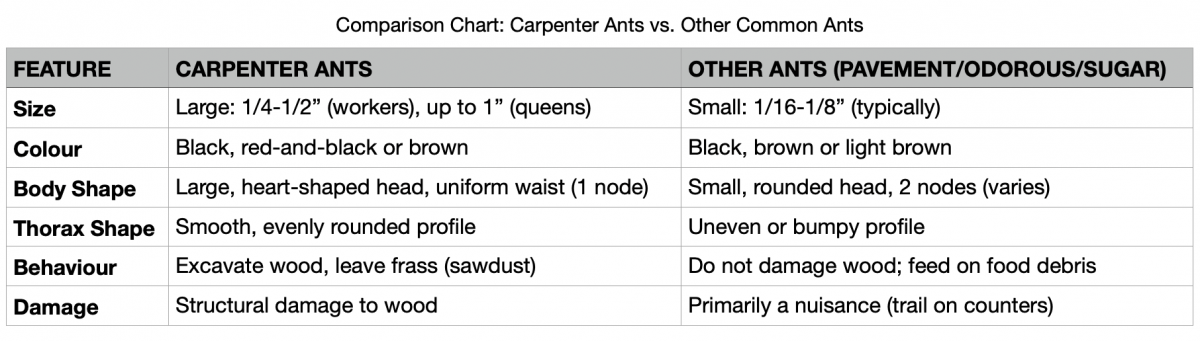
Prevention, control and management of carpenter ants differ significantly from other common household ants (e.g. sugar or pavement ants) due to their unique habit of damaging wood, their large colony structures and their preference for moisture over just food.
Management Tips
- Control Moisture: Because carpenter ants are attracted to wet, rotting wood, keeping the exterior of homes and cottages dry is essential.
- Clear away any decaying or infested wood from around buildings.
- Remove firewood from inside buildings and away from the sides of buildings.
- Do not bury stumps or other wood debris close to your house.
- Pay attention to the state of landscaping props (like decorative bark, retaining walls and driftwood).
- Correct humidity problems in your home.
- Replace decaying or infested structural wood with sound material.