The Amazing World of Flies: Diversity, Ecology and Why They're Not So Bad
Flies are often dismissed as pests, but they are among the most diverse, adaptable and ecologically important animals on Earth. From pollinating crops and wildflowers to controlling pests, recycling nutrients, and supporting food webs, flies play essential roles in both natural and human environments. This article highlights the remarkable diversity of flies, their fascinating life histories and the important services they provide. While some flies bite, the vast majority are harmless or beneficial.
Introducing the Diversity of Flies
With more than 162,000 described species and likely over one million worldwide, flies (order Diptera) rival beetles and wasps as one of the most diverse groups of animals, yet they remain relatively understudied. The defining feature of a fly is simple:
With more than 162,000 described species and likely over one million worldwide, flies (order Diptera) rival beetles and wasps as one of the most diverse groups of animals, yet they remain relatively understudied. The defining feature of a fly is simple:
- Two wings (most insects have four)
- The hind wings are modified into halteres: Small balancing organs that allow exceptional flight control and hovering
- Adults typically have sucking mouthparts
- Larvae lack segmented legs
Surviving the Extremes
Some flies have extraordinary adaptations. The goldenrod gall fly, for example, spends winter inside a plant gall exposed above the snow. Its body produces chemicals that allow tissues to partially freeze without damage. Some insects can even supercool to temperatures as low as –70°C without freezing.
Major Groups of Flies
Flies occupy nearly every habitat and ecological niche. Some notable groups include:
Some flies have extraordinary adaptations. The goldenrod gall fly, for example, spends winter inside a plant gall exposed above the snow. Its body produces chemicals that allow tissues to partially freeze without damage. Some insects can even supercool to temperatures as low as –70°C without freezing.
Major Groups of Flies
Flies occupy nearly every habitat and ecological niche. Some notable groups include:
- Crane flies – large, mosquito-like but harmless
- Tachinid flies – parasitoids that help control pest insects
- Robber flies – aerial predators that capture other insects mid-flight
- Long-legged flies – tiny metallic predators on foliage
- Midges – abundant aquatic insects that often emerge in large swarms around lakes and wetlands
- Gall midges – highly diverse plant specialists that form galls
- Bee flies – fuzzy pollinators whose larvae parasitize bees and wasps
- Dance flies – predators with elaborate courtship behaviours
- House flies – just one species within a family of more than 5,000, most of which are harmless
- Horse flies and deer flies – large biting species with aquatic larvae
- Mosquitoes – over 3,700 species worldwide, many of which do not bite humans
🤓 The common names of the members of order Diptera are written as two words: Crane fly, robber fly, bee fly, moth fly, fruit fly etc., while the common names of non-dipterans that have "fly" in their name are written as one word: Butterfly, stonefly, dragonfly, scorpionfly, sawfly, caddisfly, whitefly etc.
Life Cycles and Ecological Roles
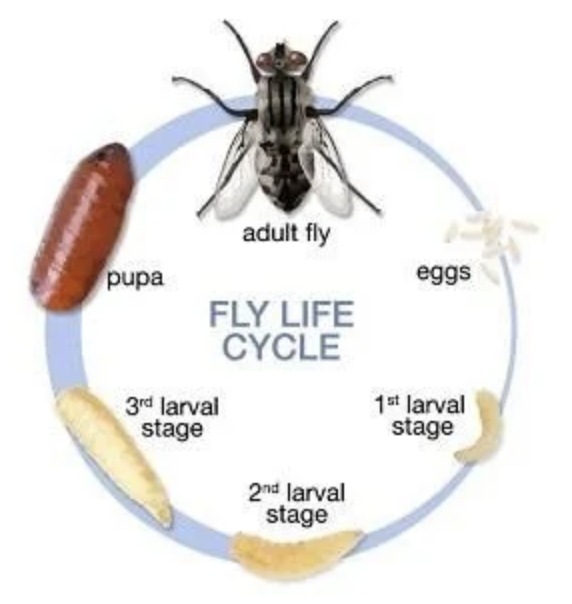
Most flies undergo complete metamorphosis: Egg → Larva → Pupa → Adult. Their larvae occupy an extraordinary range of roles:As Decomposers
Many species break down dead plants, animals, manure, and organic waste. Soldier fly larvae, including the black soldier fly, are now widely used for waste processing and animal feed.
As Plant and Fungus Feeders
Some species feed on plants or fungi. A few are agricultural pests, but most are part of natural ecosystems.
As Predators
Many fly larvae hunt other insects in soil, water, or vegetation.
As Parasitoids
Parasitoid larvae develop inside another insect and eventually kill it. The most common parasitoid, Tachinid flies, attack a wide range of insects and help keep potential pests in check. Other parasitoid groups include:
- Small-headed flies that parasitize spiders
- Thick-headed flies that attack bees and wasps
- Big-headed flies that parasitize leafhoppers and related insects
Some flies live on or in hosts without immediately killing them, such as bird-nest blowflies or botflies. Others, known as satellite flies, steal food from burrowing wasps by placing their larvae on stored prey.
Remarkable Behaviours
Flies display complex and surprising behaviours:
Flies display complex and surprising behaviours:
- Gift-giving courtship displays
- Swarming and territorial mating systems
- Extreme physical traits driven by sexual selection (such as stalked eyes)
- Hilltopping, where males gather on ridges or high points to find mates
- Bioluminescent larvae ("glowworms") that use light and sticky threads to attract and capture prey
Many flies play a critical role in regulating insect populations. For example, native flesh flies can suppress outbreaks of forest tent caterpillars for years at a time. Often, species become pests only when their natural enemies are disrupted.
Flies and Freshwater Ecosystems
Aquatic flies such as midges and black flies form the foundation of many freshwater food webs. Their larvae feed fish, birds, and amphibians and their emergence transfers nutrients from water to land.
Supporting Beneficial Flies
You can help flies and other beneficial insects by:
- Planting native species suited to local soil and moisture conditions
- Providing flowers from spring through fall
- Reducing pesticide use
- Leaving some natural areas and organic matter
- Supporting habitat corridors and naturalized spaces
A New Perspective
Flies are pollinators, predators, recyclers, and essential links in food webs. Their diversity, resilience and ecological importance make them one of the most remarkable, and under appreciated, groups of animals on the planet. The next time you see a "bee" on a flower, take a closer look. It might just be a fly.
And while you're looking, why not snap a picture or two and contribute to citizen science platforms like iNaturalist. Your observations help scientists better understand insect diversity and distribution!