Canada Lynx, Bobcats and Cougars
Canada Lynx: Specialist of the Boreal Forest
The Canada lynx is a medium-sized wild cat native to Canada’s northern forests. Built for life in deep snow, it is easily recognized by its long black ear tufts, thick silvery-grey fur, short black-tipped tail and large snowshoe-like paws.
Physical Characteristics
Adult lynx typically weigh 5–16 kg (11–35 lbs), with males larger than females. They have long legs, especially longer hind legs, which give them a slightly sloped back when standing. Their oversized paws distribute their weight over snow, allowing them to travel easily across terrain where other predators would sink.
Habitat and Distribution
In Ontario, Canada lynx are found primarily in the northern boreal forest, where dense coniferous stands and thick undergrowth provide cover for hunting. They favour mature forests but also thrive in regenerating forests after fires or logging, where prey populations increase. Although most common in northern Ontario, lynx occasionally disperse farther south during population booms. Sightings in central Ontario, including areas near Algonquin Park and in the Muskoka/Parry Sound region are uncommon but possible.
Diet and Hunting
The lynx is a highly specialized predator that relies heavily on one species: The Snowshoe hare. Snowshoe hares can make up 60–97 percent of a lynx’s diet. Because hare populations rise and fall in roughly 10-year cycles, lynx populations follow similar boom-and-bust patterns. Lynx are solitary and mostly nocturnal hunters, using stealth and short ambush attacks rather than long chases.
Physical Characteristics
Adult lynx typically weigh 5–16 kg (11–35 lbs), with males larger than females. They have long legs, especially longer hind legs, which give them a slightly sloped back when standing. Their oversized paws distribute their weight over snow, allowing them to travel easily across terrain where other predators would sink.
Habitat and Distribution
In Ontario, Canada lynx are found primarily in the northern boreal forest, where dense coniferous stands and thick undergrowth provide cover for hunting. They favour mature forests but also thrive in regenerating forests after fires or logging, where prey populations increase. Although most common in northern Ontario, lynx occasionally disperse farther south during population booms. Sightings in central Ontario, including areas near Algonquin Park and in the Muskoka/Parry Sound region are uncommon but possible.
Diet and Hunting
The lynx is a highly specialized predator that relies heavily on one species: The Snowshoe hare. Snowshoe hares can make up 60–97 percent of a lynx’s diet. Because hare populations rise and fall in roughly 10-year cycles, lynx populations follow similar boom-and-bust patterns. Lynx are solitary and mostly nocturnal hunters, using stealth and short ambush attacks rather than long chases.
Bobcats: Ontario’s Adaptable Wild Cat
While bobcats and lynxes are separate species, they do belong to the same genus, the Lynx genus. Bobcats are most likely to occur in southern parts of the province. Roughly twice the size of a domestic cat, they are recognized by their short 'bobbed tail, spotted coat and tufted ears.
Physical Characteristics
Bobcats usually weigh 5–15 kg (11–33 lbs). Their fur ranges from brownish-grey to reddish with dark spots and bars. Unlike the lynx, the top of the tail is black while the underside is white. They also have smaller paws and shorter legs than lynx, making them less adapted to deep snow but better suited to varied terrain.
Habitat and Range
Bobcats are highly adaptable and inhabit a wide range of environments across central and southern Ontario, including:
Diet and Hunting
Bobcats are opportunistic predators that hunt a wide range of prey, including:
Behaviour and Reproduction
Bobcats are solitary and territorial, typically active during dawn and dusk (crepuscular). They are excellent climbers and powerful jumpers, capable of leaping several metres in a single bound. Females usually produce one litter per year, typically in spring.
Physical Characteristics
Bobcats usually weigh 5–15 kg (11–33 lbs). Their fur ranges from brownish-grey to reddish with dark spots and bars. Unlike the lynx, the top of the tail is black while the underside is white. They also have smaller paws and shorter legs than lynx, making them less adapted to deep snow but better suited to varied terrain.
Habitat and Range
Bobcats are highly adaptable and inhabit a wide range of environments across central and southern Ontario, including:
- Mixed forests
- Swamps and wetlands
- Rocky ridges
- Brushy areas and farmland edges
Diet and Hunting
Bobcats are opportunistic predators that hunt a wide range of prey, including:
- Rabbits and hares
- Rodents and squirrels
- Birds
- Fish
- Porcupines
- Occasionally young deer
Behaviour and Reproduction
Bobcats are solitary and territorial, typically active during dawn and dusk (crepuscular). They are excellent climbers and powerful jumpers, capable of leaping several metres in a single bound. Females usually produce one litter per year, typically in spring.
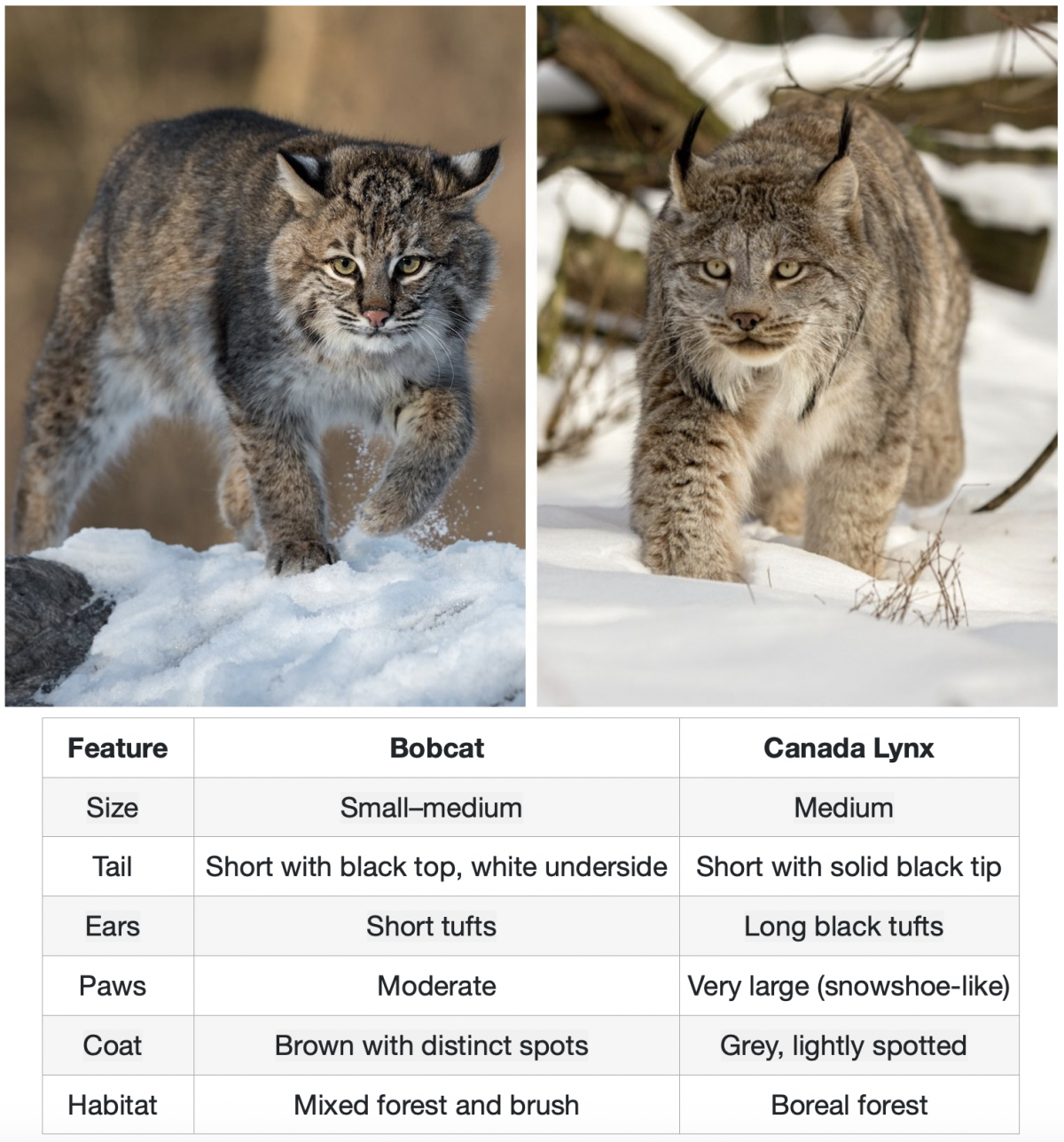
Photo Credit: https://www.reconnectwithnature.org/news-events/the-buzz/whats-the-difference-bobcat-vs-lynx
Cougars, also called mountain lions, pumas or panthers, are the largest wild cats historically associated with Ontario.
Appearance
Cougars are much larger than lynx or bobcats and are easily recognized by:
Historical Range
Cougars once ranged across much of North America, including Ontario. However, intensive hunting and habitat loss led to their disappearance from the province by the early 1900s.
Modern Sightings
Reports of cougars continue to surface across Ontario each year. While some sightings are confirmed through tracks, photos or DNA, many are difficult to verify. Some animals may be:
Safety Around Wild Cats
Encounters with wild cats are rare, but wildlife officials recommend a few basic precautions:
Appearance
Cougars are much larger than lynx or bobcats and are easily recognized by:
- A long thick tail
- A uniform tawny coat
- A large muscular body
- Small rounded ears
Historical Range
Cougars once ranged across much of North America, including Ontario. However, intensive hunting and habitat loss led to their disappearance from the province by the early 1900s.
Modern Sightings
Reports of cougars continue to surface across Ontario each year. While some sightings are confirmed through tracks, photos or DNA, many are difficult to verify. Some animals may be:
- Dispersing individuals from western populations
- Escaped or released captive animals
- Misidentified large dogs or bobcats
Safety Around Wild Cats
Encounters with wild cats are rare, but wildlife officials recommend a few basic precautions:
- Do not approach the animal, especially if young are present
- Do not run, which may trigger a chase instinct
- Stand tall and make yourself look larger
- Speak firmly and back away slowly
RESOURCES
Lynx:
- Hinterland Who’s Who: Canada Lynx
- Canadian Encyclopedia: Lynx
- Wikipedia: Canada Lynx
- National Wildlife Federation: Canada Lynx
- Animal Diversity Web: Lynx
- Smithsonian's National Zoo and Conservation Biology Institute: Canada Lynx
- What’s Ontario’s favourite animal? The case for the lynx
- Follow Me North: Canada Lynx_1
- Follow Me North: Canada Lynx_2
- Ontario Parks Blog: Canada Lynx