Weasels: Small Predators With Outsized Impact
Muskoka’s forests, wetlands, and shorelines are home to a fascinating group of small carnivores collectively known as weasels. Members of the Mustelidae family, these animals are agile hunters, equally at home slipping through dense undergrowth, tunnelling beneath snow or swimming across cold lakes.
Despite their size, they play an important role in maintaining ecological balance by controlling rodent populations and scavenging carrion. Here in Muskoka, our most common weasels include the Short-tailed Weasel (Ermine/Stoat), the Long-tailed Weasel, the Least Weasel (rare, though), the American Mink, the Fisher and American (also called Pine) Marten.
Ermine (Short-tailed Weasel)
Also known as the short-tailed weasel, the ermine is one of the smallest predators in Muskoka. In summer, it has a brown back and pale underside, but in winter it transforms into a striking white coat with a black-tipped tail. Ermines are relentless hunters, capable of taking prey larger than themselves. They are especially active beneath the snowpack in winter, using tunnels to pursue rodents.
Long-tailed Weasel
Slightly larger than the ermine, the long-tailed weasel has a more elongated body and a longer tail with a black tip. Like the ermine, it may turn white in winter, though this varies.This species prefers open woodlands, fields and forest edges. It is a fast, highly active predator, feeding primarily on small mammals, birds and occasionally insects. Its slender body allows it to pursue prey into burrows, making it especially effective at controlling rodent populations.
American Mink
Often mistaken for a "true" weasel, the mink is larger, darker and strongly tied to water. Found along lakes, rivers, and wetlands throughout Muskoka, mink are excellent swimmers. They are semi-aquatic specialists, feeding on fish, frogs, crayfish and small mammals, and are known for their opportunistic hunting style. Mink are solitary and territorial, marking their range along shorelines. Their sleek, water-resistant fur allows them to remain active even in cold conditions.
American (Pine) Marten
The marten is a tree-loving member of the weasel family, typically found in mature coniferous forests. It has a slender body, bushy tail and a distinctive orange or yellow throat patch. Martens are agile climbers and spend much of their time in trees, hunting squirrels, birds and small mammals. In Ontario, they are more common in northern forests but may occasionally be found in suitable habitat in Muskoka.
Fisher
Despite its name, the fisher is not a fish-eater but a powerful forest predator. Larger and more robust than other weasels, fishers are known for their ability to prey on animals such as snowshoe hares and even porcupines. They inhabit mixed and dense forests and are excellent climbers, though they spend much of their time on the ground. Fishers are elusive but increasingly reported in parts of central Ontario, including Muskoka.
Identification at a Glance
Weasels are built for hunting. Their long, flexible bodies and short legs allow them to chase prey through tunnels, logs and dense vegetation. They are also known for their high metabolism, meaning they must hunt frequently to survive. Many species remain active year-round. In winter, smaller weasels hunt beneath the snow, while larger relatives roam above it. Some, like the ermine, rely on camouflage, while others depend on stealth and speed.
Ecological Importance
Weasels are key mid-level predators (mesopredators). By controlling populations of mice, voles and other small animals, they help prevent overgrazing of vegetation and reduce the spread of disease. At the same time, they are prey for larger predators such as owls, foxes and coyotes, making them an important link in the food web.
Living with Weasels
Although rarely seen, weasels sometimes venture near cottages and rural homes. They may enter sheds or outbuildings in search of rodents. While their presence can be surprising, they are generally beneficial animals to have nearby due to their pest-control habits. If encountered, it’s best to observe from a distance and avoid handling them. Like all wild animals, they can bite if threatened.
A Hidden but Vital Presence
Weasels and their relatives are among Muskoka’s most elusive mammals. Quick, quiet and often unnoticed, they move through forests, fields, and shorelines performing an essential ecological role. Whether it’s the tiny ermine hunting beneath the snow or the powerful fisher roaming the woods, these small predators are a reminder that even the most secretive animals can have a big impact on the natural world.
Ermine (Short-tailed Weasel)
Also known as the short-tailed weasel, the ermine is one of the smallest predators in Muskoka. In summer, it has a brown back and pale underside, but in winter it transforms into a striking white coat with a black-tipped tail. Ermines are relentless hunters, capable of taking prey larger than themselves. They are especially active beneath the snowpack in winter, using tunnels to pursue rodents.
Long-tailed Weasel
Slightly larger than the ermine, the long-tailed weasel has a more elongated body and a longer tail with a black tip. Like the ermine, it may turn white in winter, though this varies.This species prefers open woodlands, fields and forest edges. It is a fast, highly active predator, feeding primarily on small mammals, birds and occasionally insects. Its slender body allows it to pursue prey into burrows, making it especially effective at controlling rodent populations.
American Mink
Often mistaken for a "true" weasel, the mink is larger, darker and strongly tied to water. Found along lakes, rivers, and wetlands throughout Muskoka, mink are excellent swimmers. They are semi-aquatic specialists, feeding on fish, frogs, crayfish and small mammals, and are known for their opportunistic hunting style. Mink are solitary and territorial, marking their range along shorelines. Their sleek, water-resistant fur allows them to remain active even in cold conditions.
American (Pine) Marten
The marten is a tree-loving member of the weasel family, typically found in mature coniferous forests. It has a slender body, bushy tail and a distinctive orange or yellow throat patch. Martens are agile climbers and spend much of their time in trees, hunting squirrels, birds and small mammals. In Ontario, they are more common in northern forests but may occasionally be found in suitable habitat in Muskoka.
Fisher
Despite its name, the fisher is not a fish-eater but a powerful forest predator. Larger and more robust than other weasels, fishers are known for their ability to prey on animals such as snowshoe hares and even porcupines. They inhabit mixed and dense forests and are excellent climbers, though they spend much of their time on the ground. Fishers are elusive but increasingly reported in parts of central Ontario, including Muskoka.
Identification at a Glance
- True weasels (ermine, long-tailed weasel) are small and slender; mink, martens, and fishers are progressively larger.
- A black-tipped tail is typical of ermine and long-tailed weasels.
- Habitat hints:
- Near water → likely mink
- Deep forest → marten or fisher
- Fields/edges → true weasels
- Winter coat: Ermine (and sometimes long-tailed weasels) turn white in winter; others remain brown.
Weasels are built for hunting. Their long, flexible bodies and short legs allow them to chase prey through tunnels, logs and dense vegetation. They are also known for their high metabolism, meaning they must hunt frequently to survive. Many species remain active year-round. In winter, smaller weasels hunt beneath the snow, while larger relatives roam above it. Some, like the ermine, rely on camouflage, while others depend on stealth and speed.
Ecological Importance
Weasels are key mid-level predators (mesopredators). By controlling populations of mice, voles and other small animals, they help prevent overgrazing of vegetation and reduce the spread of disease. At the same time, they are prey for larger predators such as owls, foxes and coyotes, making them an important link in the food web.
Living with Weasels
Although rarely seen, weasels sometimes venture near cottages and rural homes. They may enter sheds or outbuildings in search of rodents. While their presence can be surprising, they are generally beneficial animals to have nearby due to their pest-control habits. If encountered, it’s best to observe from a distance and avoid handling them. Like all wild animals, they can bite if threatened.
A Hidden but Vital Presence
Weasels and their relatives are among Muskoka’s most elusive mammals. Quick, quiet and often unnoticed, they move through forests, fields, and shorelines performing an essential ecological role. Whether it’s the tiny ermine hunting beneath the snow or the powerful fisher roaming the woods, these small predators are a reminder that even the most secretive animals can have a big impact on the natural world.
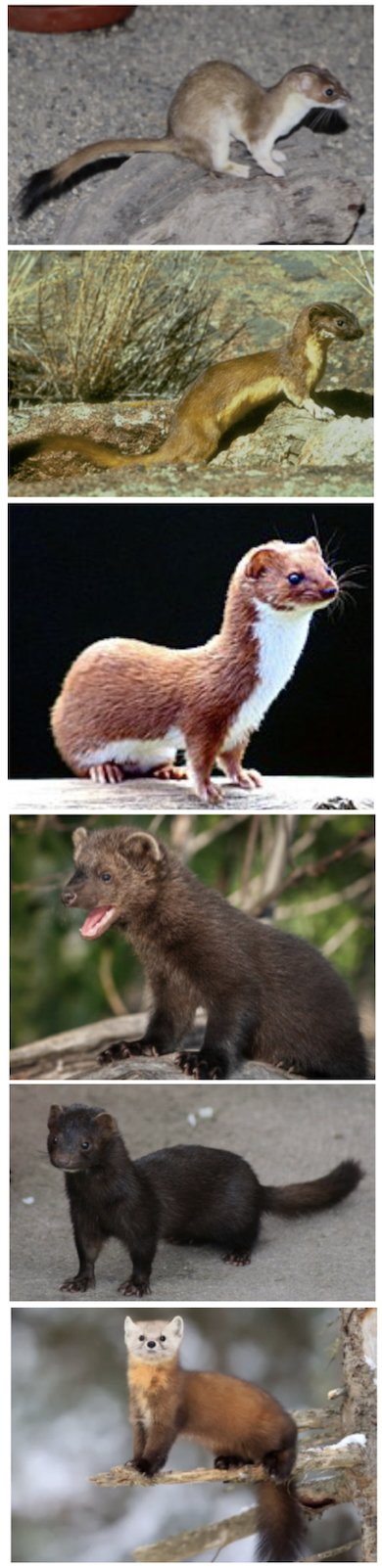
Pictured top to bottom:
Short-tailed weasel (ermine)
Long-tailed weasel
Least weasel
Fisher
Mink
Marten
Source: OntarioWildlifeRescue.ca